Home
Blogs

Designing Fair and Scalable Carry Plans for Private Capital Firms

Carry plans built for Fund I rarely survive Fund III. Here's how to design structures that scale with your firm.
Published
3/30/2026
Author
Navable Team

How to Design Carry Plans That Scale: A Guide for Growing Private Capital Firms

  • Carry plans that work for Fund I almost always break by Fund III — not because of bad design, but because they were never built for the complexity that growth introduces.
  • The core tension is fairness vs. scalability: the more precisely a plan reflects individual contribution, the harder it becomes to operate across multiple funds, vintages, and participants.
  • Most operational pain comes not from carry design but from carry tracking — managing allocations, vesting, forfeitures, and distributions as they change over time across an expanding firm.
  • Firms that get this right separate the strategic decisions (who gets what) from the operational infrastructure (how it's tracked, reconciled, and reported) — and invest in systems built for the latter.

In a firm's early days, carried interest feels straightforward. A small team, one fund, everyone around the table — you know who did what, who earned what, and how the economics should split. Allocations are equal or close to it, documentation is light, and the model lives in a single spreadsheet (or sometimes just in someone's head).

That simplicity works beautifully when you have three partners and one fund. It starts to fracture the moment you raise Fund II, bring in a lateral hire, or try to explain the allocation logic to an auditor who wasn't in the room when those handshake decisions were made.

Fund I gets built on trust and proximity. By Fund III, you need structure — whether you planned for it or not. And the gap between how carry was designed and how it actually needs to be managed is where most operational pain begins.

The Core Tension in Carry Plan Design: Fairness vs. Scalability

Every carry plan attempts to answer the same fundamental questions. Who sourced the deal? Who led it? Who added value post-close? Who took risk before there was a track record to stand behind?

The more a firm grows, the more nuanced these questions become. A founding partner who sourced three of five deals in Fund I may source none in Fund III but still manage the portfolio. A new hire negotiated carry participation in existing funds as part of their offer letter. A principal who left mid-fund triggered a forfeiture clause that nobody fully documented.

The instinct is to design carry structures that capture all of this nuance — different allocations per deal, adjustments based on contribution and timing, exceptions for key hires, side agreements for specific situations. Individually, each decision makes sense. Collectively, they create a system that becomes genuinely difficult to track, explain, and maintain.

Scalability requires the opposite: consistency, repeatability, clear rules, and minimal exceptions. The tension between these two forces is unavoidable, and most firms don't consciously choose between them. They drift — adding exceptions and carve-outs over time — until the structure becomes difficult to manage. By the time someone flags the problem, the complexity is already deeply embedded.

How Carry Structures Actually Evolve as Firms Grow

Across the industry, the evolution follows a remarkably consistent pattern.

Stage 1: Founding Simplicity

In early funds, carry is typically split equally (or close to it) among founding partners. There's limited differentiation, minimal formal documentation, and a shared understanding of who contributed what. Decisions are fast, adjustments are informal, and nobody needs a system because the "system" is a conversation over lunch.

At this stage, complexity is low — and so is the need for infrastructure to manage it.

Stage 2: Growth and Differentiation

As the team expands, roles become more specialized and contribution varies more meaningfully across partners. Carry starts to reflect that reality through role-based allocations, tiered participation between senior and junior team members, and early experiments with deal-level carry.

This is where complexity begins — not because anything is broken, but because the structure is becoming more tailored to a broader set of participants with different expectations.

Stage 3: Institutionalization

By the time a firm is managing three or four funds across overlapping vintages, carry exists on multiple parallel timelines. Team composition changes mid-fund. Allocations differ across funds, deals, and participants. Documentation becomes formal out of necessity. LP scrutiny intensifies. Internal expectations around transparency — from partners, from employees, from the board — rise sharply.

What used to be a compensation model has quietly become an operational system. And that system often rests on infrastructure (typically spreadsheets and tribal knowledge) that was never designed to carry this weight.

The Complexity Drivers Most Firms Underestimate

Growth introduces layers of carry complexity that are hard to anticipate until you're living with them.

Overlapping fund vintages mean allocations run on different timelines, participants enter at different points, and carry from older funds continues alongside new structures. Tracking who owns what across vintages is non-trivial, especially when team composition shifts mid-cycle.

New partners and lateral hires raise difficult allocation questions that rarely have clean answers. How much carry should a new partner receive? Do they participate in existing funds, or only new ones? How do you avoid diluting founding partners while still making competitive offers? Most firms layer new allocations on top of existing structures, which compounds complexity with every hire.

Deal-level participation (jump-ball carry) is logical in theory — not every partner works on every deal, so carry should reflect actual involvement. In practice, it creates fragmentation: different participants across different deals, different allocation percentages, and an exponentially larger tracking burden.

Phantom carry and synthetic structures solve a real retention problem by providing economic exposure without formal ownership. But they sit alongside traditional carry allocations with different vesting schedules, different payout mechanics, and different tax treatment — adding another layer to track, communicate, and reconcile.

Co-invest and hybrid participation add yet another dimension. When participants have both carry and capital exposure, economic outcomes split across structures, and participation varies deal by deal, the line between ownership and incentive compensation becomes blurred. The model gets harder to explain — both internally and to LPs asking pointed questions.

The Hidden Operational Burden of Carry Management

Designing a carry plan is one challenge. Actually managing it across years, funds, and personnel changes is a fundamentally different problem — and the one most firms underestimate.

Carry design is static on paper, but the reality underneath it is constantly shifting. Behind the scenes, finance and operations teams are dealing with tracking ownership changes over time, reconciling allocations across funds, deals, and entities, maintaining an audit trail that can withstand scrutiny, and answering questions that sound simple but aren't: Who owned what at the time of this exit? How did this allocation change after the Q3 rebalancing? Which participants should be included in this distribution, and at what percentages?

The critical distinction here is between carry design (which defines intent) and carry tracking (which reflects reality). Intent gets set once. Reality changes constantly — people leave, allocations shift, vesting schedules adjust, structures evolve. What was agreed six months ago may not reflect the current state, and the spreadsheet that was "good enough" in Fund I becomes a genuine operational liability by Fund III.

Not because the math is wrong. Because the model can no longer keep pace with the decisions being made around it.

---

Six Carry Plan Mistakes That Surface Too Late

These patterns are consistent across the industry — and almost always only visible in hindsight.

1. Over-optimizing for fairness in early funds. Trying to perfectly reflect individual contribution from day one creates bespoke structures that become fiendishly difficult to manage as the firm scales.

2. Designing for the current fund, not the next three. Carry plans built specifically for Fund I, without considering how they extend to Fund II and beyond, often require painful restructuring later.

3. Mixing fund-level and deal-level carry without a clear framework. Combining these approaches ad hoc — often in response to specific partner requests — leads to fragmentation and internal confusion about which logic applies where.

4. Weak documentation of allocation decisions. What made perfect sense at the time becomes nearly impossible to reconstruct two years later, especially during audits or when a departing partner challenges their forfeiture terms.

5. Relying on spreadsheets past their useful life. Spreadsheets work for Fund I. By the time you're managing carry across three funds, two co-invest vehicles, and a continuation fund, version control, reconciliation, and auditability become serious operational risks.

6. Disconnecting allocation tracking from distribution workflows. When ownership data and distribution models live in separate systems (or separate tabs), errors become almost inevitable — and they tend to surface at the worst possible moments.

Most carry plans don't fail because of bad design. They fail because they were never built to be operated at scale.

What Well-Managed Carry Plans Have in Common

There's no perfect carry plan. But firms that manage this well share recognizable patterns.

They define clear allocation frameworks upfront rather than making one-off decisions that accumulate into an unmanageable patchwork. They separate carry design (the strategic "who gets what and why") from carry tracking (the operational "what actually happened, and can we prove it"). They maintain time-aware ownership records that reflect the full history of changes — not just the current snapshot. And they build systems, not just models, recognizing that carry management is an ongoing operational discipline, not a one-time modeling exercise.

Critically, they also accept tradeoffs. Not every edge case needs to be solved perfectly. Not every allocation needs to be hyper-optimized for individual contribution. What matters is that the overall system can be understood, maintained, and trusted over time — by partners, by employees, by auditors, and by LPs.

The Shift That Growing Firms Eventually Make

At some point, complexity forces a change. Not because firms want to overhaul their approach — but because they have to.

The shift typically moves from ad hoc decisions to structured frameworks, from static allocations to dynamic ownership tracking, and from spreadsheets to purpose-built systems that can handle the full lifecycle of carry: allocations, vesting, forfeitures, reallocations, distributions, and reporting.

This is less about adopting new technology for its own sake and more about operational necessity. As fund structures evolve and participant counts grow, the need for a centralized, audit-ready system of record becomes unavoidable.

Platforms like [Navable](https://www.navable.com/solutions/carried-interest-software) sit in exactly this layer — purpose-built to help firms manage carry plans, allocations, vesting rules, co-invest programs, and compensation across funds and participants as they change over time. The platform replaces fragmented spreadsheets with a single source of truth, complete with audit trails and stakeholder visibility, so that CFOs and operations teams can spend less time reconciling and more time running the business.

Because eventually, the question shifts from "How should we design this?" to "Can we actually manage what we've already built?"

Design for the Firm You're Becoming

Carry plans tend to be designed for the firm as it exists today. They should be designed for the firm you're becoming — because growth introduces complexity whether you plan for it or not. More funds, more people, more edge cases, more scrutiny.

The goal isn't to eliminate that complexity. That's not realistic in private capital. The goal is to design structures — and the operational systems that support them — capable of absorbing it.

The firms that get this right aren't necessarily the ones with the most elegant carry models. They're the ones that can explain, defend, and operate those models years later, across multiple funds, with complete confidence and a clean audit trail.

That's ultimately what separates a carry plan from a carry system.

FAQs: Carry Plan Design for Growing Private Capital Firms

What is a carry plan in private equity?

A carry plan defines how carried interest — the GP's share of fund profits — is allocated among partners, employees, and other participants. It includes allocation percentages, vesting schedules, forfeiture rules, and the terms governing how carry is earned and distributed across funds and deals.

When should a firm move from a simple carry split to a structured carry plan?

Most firms hit the trigger point when raising Fund II or III, bringing in lateral partners, or expanding carry participation beyond founding members. Any time allocations become differentiated across participants or funds, a structured framework reduces the risk of errors, disputes, and audit exposure.

What is the difference between fund-level and deal-level carry?

Fund-level carry (European waterfall) calculates carried interest across the entire fund — LPs receive all capital and preferred returns before the GP earns carry. Deal-level carry (American waterfall) calculates on each investment individually, which can accelerate GP payouts but introduces clawback risk and additional tracking complexity.

Why do carry plans break down as firms scale?

The most common cause is accumulated complexity: overlapping fund vintages, mid-fund personnel changes, deal-level participation, phantom carry structures, co-invest programs, and side letters that create one-off exceptions. Each addition is logical in isolation, but collectively they create a system that's difficult to track, reconcile, and audit.

How does carry management software help?

Purpose-built carry management platforms like Navable centralize carry plans, allocations, vesting rules, and participant data into a single system of record with full audit trails. This replaces fragmented spreadsheets, reduces reconciliation time, improves accuracy, and gives partners and employees transparent visibility into their carry and compensation.


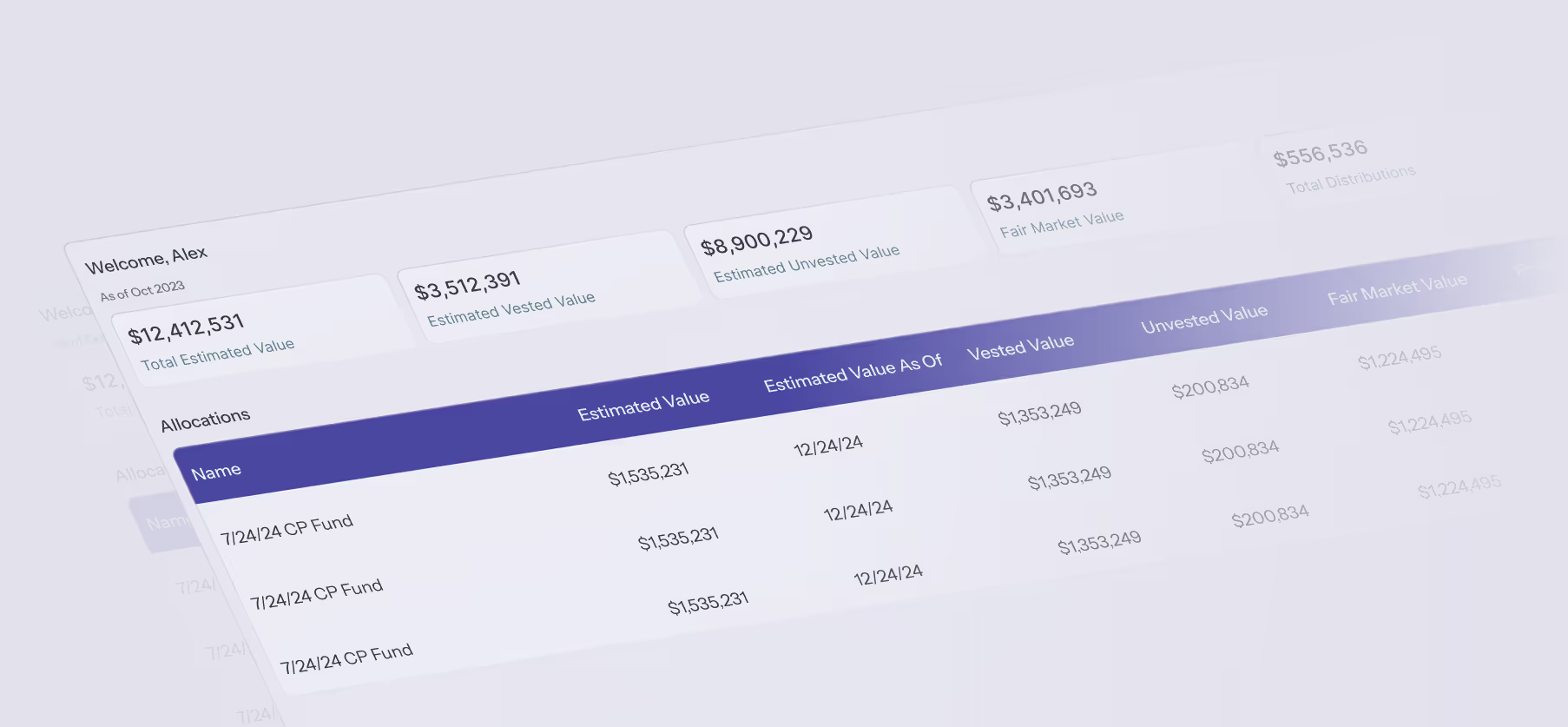
Financial dashboard showing totals and allocations including total estimated value, vested value, unvested value, and fair market value.

Have questions? We have answers

Book time with our expert team

Thank you, now select a meeting time

Choose Your Time
Oops! Something went wrong while submitting the form.
Thank you for contacting us! A team member will be in touch shortly. In the meantime, you can connect with us on LinkedIn!
Linked In Icon White for Navable
Oops! Something went wrong while submitting the form.
Abstract pattern of white square dots arranged in varying vertical columns on a black background.
Home
Blog insights
Designing Fair and Scalable Carry Plans for Private Capital Firms

Designing Fair and Scalable Carry Plans for Private Capital Firms

Carry plans built for Fund I rarely survive Fund III. Here's how to design structures that scale with your firm.

March 30, 2026
copilot logo
Written by:

How to Design Carry Plans That Scale: A Guide for Growing Private Capital Firms

  • Carry plans that work for Fund I almost always break by Fund III — not because of bad design, but because they were never built for the complexity that growth introduces.
  • The core tension is fairness vs. scalability: the more precisely a plan reflects individual contribution, the harder it becomes to operate across multiple funds, vintages, and participants.
  • Most operational pain comes not from carry design but from carry tracking — managing allocations, vesting, forfeitures, and distributions as they change over time across an expanding firm.
  • Firms that get this right separate the strategic decisions (who gets what) from the operational infrastructure (how it's tracked, reconciled, and reported) — and invest in systems built for the latter.

In a firm's early days, carried interest feels straightforward. A small team, one fund, everyone around the table — you know who did what, who earned what, and how the economics should split. Allocations are equal or close to it, documentation is light, and the model lives in a single spreadsheet (or sometimes just in someone's head).

That simplicity works beautifully when you have three partners and one fund. It starts to fracture the moment you raise Fund II, bring in a lateral hire, or try to explain the allocation logic to an auditor who wasn't in the room when those handshake decisions were made.

Fund I gets built on trust and proximity. By Fund III, you need structure — whether you planned for it or not. And the gap between how carry was designed and how it actually needs to be managed is where most operational pain begins.

The Core Tension in Carry Plan Design: Fairness vs. Scalability

Every carry plan attempts to answer the same fundamental questions. Who sourced the deal? Who led it? Who added value post-close? Who took risk before there was a track record to stand behind?

The more a firm grows, the more nuanced these questions become. A founding partner who sourced three of five deals in Fund I may source none in Fund III but still manage the portfolio. A new hire negotiated carry participation in existing funds as part of their offer letter. A principal who left mid-fund triggered a forfeiture clause that nobody fully documented.

The instinct is to design carry structures that capture all of this nuance — different allocations per deal, adjustments based on contribution and timing, exceptions for key hires, side agreements for specific situations. Individually, each decision makes sense. Collectively, they create a system that becomes genuinely difficult to track, explain, and maintain.

Scalability requires the opposite: consistency, repeatability, clear rules, and minimal exceptions. The tension between these two forces is unavoidable, and most firms don't consciously choose between them. They drift — adding exceptions and carve-outs over time — until the structure becomes difficult to manage. By the time someone flags the problem, the complexity is already deeply embedded.

How Carry Structures Actually Evolve as Firms Grow

Across the industry, the evolution follows a remarkably consistent pattern.

Stage 1: Founding Simplicity

In early funds, carry is typically split equally (or close to it) among founding partners. There's limited differentiation, minimal formal documentation, and a shared understanding of who contributed what. Decisions are fast, adjustments are informal, and nobody needs a system because the "system" is a conversation over lunch.

At this stage, complexity is low — and so is the need for infrastructure to manage it.

Stage 2: Growth and Differentiation

As the team expands, roles become more specialized and contribution varies more meaningfully across partners. Carry starts to reflect that reality through role-based allocations, tiered participation between senior and junior team members, and early experiments with deal-level carry.

This is where complexity begins — not because anything is broken, but because the structure is becoming more tailored to a broader set of participants with different expectations.

Stage 3: Institutionalization

By the time a firm is managing three or four funds across overlapping vintages, carry exists on multiple parallel timelines. Team composition changes mid-fund. Allocations differ across funds, deals, and participants. Documentation becomes formal out of necessity. LP scrutiny intensifies. Internal expectations around transparency — from partners, from employees, from the board — rise sharply.

What used to be a compensation model has quietly become an operational system. And that system often rests on infrastructure (typically spreadsheets and tribal knowledge) that was never designed to carry this weight.

The Complexity Drivers Most Firms Underestimate

Growth introduces layers of carry complexity that are hard to anticipate until you're living with them.

Overlapping fund vintages mean allocations run on different timelines, participants enter at different points, and carry from older funds continues alongside new structures. Tracking who owns what across vintages is non-trivial, especially when team composition shifts mid-cycle.

New partners and lateral hires raise difficult allocation questions that rarely have clean answers. How much carry should a new partner receive? Do they participate in existing funds, or only new ones? How do you avoid diluting founding partners while still making competitive offers? Most firms layer new allocations on top of existing structures, which compounds complexity with every hire.

Deal-level participation (jump-ball carry) is logical in theory — not every partner works on every deal, so carry should reflect actual involvement. In practice, it creates fragmentation: different participants across different deals, different allocation percentages, and an exponentially larger tracking burden.

Phantom carry and synthetic structures solve a real retention problem by providing economic exposure without formal ownership. But they sit alongside traditional carry allocations with different vesting schedules, different payout mechanics, and different tax treatment — adding another layer to track, communicate, and reconcile.

Co-invest and hybrid participation add yet another dimension. When participants have both carry and capital exposure, economic outcomes split across structures, and participation varies deal by deal, the line between ownership and incentive compensation becomes blurred. The model gets harder to explain — both internally and to LPs asking pointed questions.

The Hidden Operational Burden of Carry Management

Designing a carry plan is one challenge. Actually managing it across years, funds, and personnel changes is a fundamentally different problem — and the one most firms underestimate.

Carry design is static on paper, but the reality underneath it is constantly shifting. Behind the scenes, finance and operations teams are dealing with tracking ownership changes over time, reconciling allocations across funds, deals, and entities, maintaining an audit trail that can withstand scrutiny, and answering questions that sound simple but aren't: Who owned what at the time of this exit? How did this allocation change after the Q3 rebalancing? Which participants should be included in this distribution, and at what percentages?

The critical distinction here is between carry design (which defines intent) and carry tracking (which reflects reality). Intent gets set once. Reality changes constantly — people leave, allocations shift, vesting schedules adjust, structures evolve. What was agreed six months ago may not reflect the current state, and the spreadsheet that was "good enough" in Fund I becomes a genuine operational liability by Fund III.

Not because the math is wrong. Because the model can no longer keep pace with the decisions being made around it.

---

Six Carry Plan Mistakes That Surface Too Late

These patterns are consistent across the industry — and almost always only visible in hindsight.

1. Over-optimizing for fairness in early funds. Trying to perfectly reflect individual contribution from day one creates bespoke structures that become fiendishly difficult to manage as the firm scales.

2. Designing for the current fund, not the next three. Carry plans built specifically for Fund I, without considering how they extend to Fund II and beyond, often require painful restructuring later.

3. Mixing fund-level and deal-level carry without a clear framework. Combining these approaches ad hoc — often in response to specific partner requests — leads to fragmentation and internal confusion about which logic applies where.

4. Weak documentation of allocation decisions. What made perfect sense at the time becomes nearly impossible to reconstruct two years later, especially during audits or when a departing partner challenges their forfeiture terms.

5. Relying on spreadsheets past their useful life. Spreadsheets work for Fund I. By the time you're managing carry across three funds, two co-invest vehicles, and a continuation fund, version control, reconciliation, and auditability become serious operational risks.

6. Disconnecting allocation tracking from distribution workflows. When ownership data and distribution models live in separate systems (or separate tabs), errors become almost inevitable — and they tend to surface at the worst possible moments.

Most carry plans don't fail because of bad design. They fail because they were never built to be operated at scale.

What Well-Managed Carry Plans Have in Common

There's no perfect carry plan. But firms that manage this well share recognizable patterns.

They define clear allocation frameworks upfront rather than making one-off decisions that accumulate into an unmanageable patchwork. They separate carry design (the strategic "who gets what and why") from carry tracking (the operational "what actually happened, and can we prove it"). They maintain time-aware ownership records that reflect the full history of changes — not just the current snapshot. And they build systems, not just models, recognizing that carry management is an ongoing operational discipline, not a one-time modeling exercise.

Critically, they also accept tradeoffs. Not every edge case needs to be solved perfectly. Not every allocation needs to be hyper-optimized for individual contribution. What matters is that the overall system can be understood, maintained, and trusted over time — by partners, by employees, by auditors, and by LPs.

The Shift That Growing Firms Eventually Make

At some point, complexity forces a change. Not because firms want to overhaul their approach — but because they have to.

The shift typically moves from ad hoc decisions to structured frameworks, from static allocations to dynamic ownership tracking, and from spreadsheets to purpose-built systems that can handle the full lifecycle of carry: allocations, vesting, forfeitures, reallocations, distributions, and reporting.

This is less about adopting new technology for its own sake and more about operational necessity. As fund structures evolve and participant counts grow, the need for a centralized, audit-ready system of record becomes unavoidable.

Platforms like [Navable](https://www.navable.com/solutions/carried-interest-software) sit in exactly this layer — purpose-built to help firms manage carry plans, allocations, vesting rules, co-invest programs, and compensation across funds and participants as they change over time. The platform replaces fragmented spreadsheets with a single source of truth, complete with audit trails and stakeholder visibility, so that CFOs and operations teams can spend less time reconciling and more time running the business.

Because eventually, the question shifts from "How should we design this?" to "Can we actually manage what we've already built?"

Design for the Firm You're Becoming

Carry plans tend to be designed for the firm as it exists today. They should be designed for the firm you're becoming — because growth introduces complexity whether you plan for it or not. More funds, more people, more edge cases, more scrutiny.

The goal isn't to eliminate that complexity. That's not realistic in private capital. The goal is to design structures — and the operational systems that support them — capable of absorbing it.

The firms that get this right aren't necessarily the ones with the most elegant carry models. They're the ones that can explain, defend, and operate those models years later, across multiple funds, with complete confidence and a clean audit trail.

That's ultimately what separates a carry plan from a carry system.

FAQs: Carry Plan Design for Growing Private Capital Firms

What is a carry plan in private equity?

A carry plan defines how carried interest — the GP's share of fund profits — is allocated among partners, employees, and other participants. It includes allocation percentages, vesting schedules, forfeiture rules, and the terms governing how carry is earned and distributed across funds and deals.

When should a firm move from a simple carry split to a structured carry plan?

Most firms hit the trigger point when raising Fund II or III, bringing in lateral partners, or expanding carry participation beyond founding members. Any time allocations become differentiated across participants or funds, a structured framework reduces the risk of errors, disputes, and audit exposure.

What is the difference between fund-level and deal-level carry?

Fund-level carry (European waterfall) calculates carried interest across the entire fund — LPs receive all capital and preferred returns before the GP earns carry. Deal-level carry (American waterfall) calculates on each investment individually, which can accelerate GP payouts but introduces clawback risk and additional tracking complexity.

Why do carry plans break down as firms scale?

The most common cause is accumulated complexity: overlapping fund vintages, mid-fund personnel changes, deal-level participation, phantom carry structures, co-invest programs, and side letters that create one-off exceptions. Each addition is logical in isolation, but collectively they create a system that's difficult to track, reconcile, and audit.

How does carry management software help?

Purpose-built carry management platforms like Navable centralize carry plans, allocations, vesting rules, and participant data into a single system of record with full audit trails. This replaces fragmented spreadsheets, reduces reconciliation time, improves accuracy, and gives partners and employees transparent visibility into their carry and compensation.

Financial dashboard showing totals and allocations including total estimated value, vested value, unvested value, and fair market value.

Have questions? We have answers

Book time with our expert team

Thank you, now select a meeting time

Choose Your Time
Oops! Something went wrong while submitting the form.
Thank you for contacting us! A team member will be in touch shortly. In the meantime, you can connect with us on LinkedIn!
Linked In Icon White for Navable
Oops! Something went wrong while submitting the form.
Abstract pattern of white square dots arranged in varying vertical columns on a black background.