.svg)


What a Centralized Carry Engine Actually Is
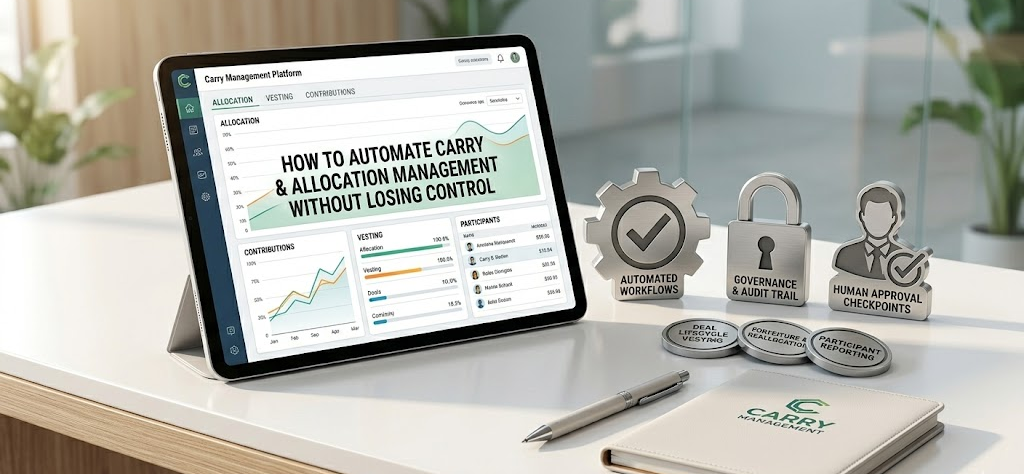
A lot of tools claim to "do carry." A centralized carry engine is more specific: a system that applies consistent carry allocation rules across all funds and deals, using a single dataset and a traceable calculation history.
Think of it as Rules + Data + Audit Trail.
At its core, a carry engine:
- Encodes fund terms, allocation rules, and vesting schedules in one governed environment
- Produces repeatable outputs (allocations, statements, summaries) without rebuilding logic each quarter
- Maintains a complete audit trail so when someone asks "who changed what, when, and why?" the answer takes seconds
What it's not: a one-off calculator for a single distribution, a static workbook only one person understands, or a black box with no transparency into assumptions. If your firm can't explain the numbers without pulling a specific employee into the room, you don't have a carry system. You have a carry dependency.
Key Takeaways
- A centralized carry engine replaces fragmented spreadsheets with a governed system of record: one dataset, consistent logic, repeatable outputs, and a full audit trail across every fund and participant.
- It eliminates quarter-end fire drills by automating distribution runs, partner review cycles, and the "what changed?" reconciliation work that consumes finance teams.
- It scales with real-world complexity (multi-fund participation, deal-by-deal vs. fund-level carry, leavers, co-invest, side letters) without breaking or requiring heroic manual effort.
- For CFOs and GPs, the payoff goes beyond operational efficiency. It's confidence: the ability to explain, defend, and distribute carry with numbers you trust.
- Most private equity firms don't have "one" carry model; but a web of spreadsheets, email approvals, fund administrator exports, and a handful of people who know how to navigate
- That patchwork holds until a distribution event lands, an auditor asks for change history, or a departing partner questions their forfeiture terms, and the fragility of the whole setup becomes impossible to ignore.
Acentralized carry engine solves this by turning carry from a quarterly spreadsheet exercise into a governed system of record. Not a calculator, but infrastructure: rules, data, and audit trail in one place, producing repeatable outputs without rebuilding logic every cycle.
The "Before" State: Carry Without a System

Here's the reality most CFOs recognize around quarter-end and distribution events.
Carry processes evolve into an accidental patchwork:
- Fund admin exports in PDF and Excel
- Internal carry spreadsheets organized by fund, vintage, or deal
- Cap table and co-invest trackers in separate files
- Email threads handling approvals, exceptions, and "can you rerun that?" requests
Over time, you don't just have spreadsheets. You have spreadsheet ecosystems. And the ecosystem quietly becomes the operating model.
The symptoms are predictable:
- Version control breakdown. "final_final_v9" is somehow different from "final_final_v9_REVISED"
- Key-person dependency. Only the model builder can run the model
- Slow distribution cycles. Every run requires manual cross-checks
- Conflicting numbers across teams. Finance, deal teams, and IR each look at a different "truth"
Even when the math is technically correct, the process is brittle. Every cycle depends on manual steps, institutional memory, and the assumption that nothing unexpected will surface.
The cost goes beyond hours spent reconciling. It's the risk of misallocation when a broken formula distributes real dollars. It's the audit pain of reconstructing allocation changes from email threads. And it's the erosion of trust when partners or LPs can't reconcile numbers quickly, even if the final answer turns out right.
Why Carry Breaks First When Firms Scale
Carry rarely breaks when a firm is small and simple. It breaks when reality becomes multi-dimensional, and that happens faster than most firms expect.
Multiple funds with different economics. Fund I and Fund II have different carry pools, hurdles, and vesting start dates. Partners get promoted, new hires join between fund closes, and Excel ends up with parallel models and manual "bridges" between them. That's exactly where errors hide.
Deal-by-deal vs. fund-level carry. Hybrid structures create timing mismatches that are difficult to reconcile. Who has "earned" carry vs. "vested" vs. "received" it? The definitions change by structure, and spreadsheets struggle to maintain consistent narratives across multiple approaches running simultaneously.
Leavers and transfers. Forfeitures, vesting acceleration, transfers across entities, eligibility changes over time. When employee movement intersects with multiple funds and different vesting policies, mismatches emerge between what the partnership intended, what the documents say, and what the spreadsheet calculates.
Co-invest alongside carry. When participants hold both carry and capital exposure with different cashflow timing, the firm needs to present a combined picture. But when these are tracked separately, even basic questions get hard to answer: What's my total exposure? When does it vest?
Each complexity is manageable alone. Combined, they create an environment where spreadsheets cannot keep pace.
The Turning Point
Firms typically hit the inflection when they:
- Launch Fund II or III
- Add new strategies (credit, growth, real assets)
- Face institutional LP due diligence and heightened audit scrutiny
- Broaden carry participation beyond founding partners
After the turning point, stakeholder expectations shift in ways spreadsheets can't accommodate. Partners expect repeatable, explainable calculations. Finance teams need self-serve reporting, not ad-hoc reconciliation. Auditors require documented change history as standard operating procedure, not a year-end scramble.
When expectations change, spreadsheets don't improve. They just become riskier.
Life After Centralization
A centralized carry engine changes how fund operations runs day to day.
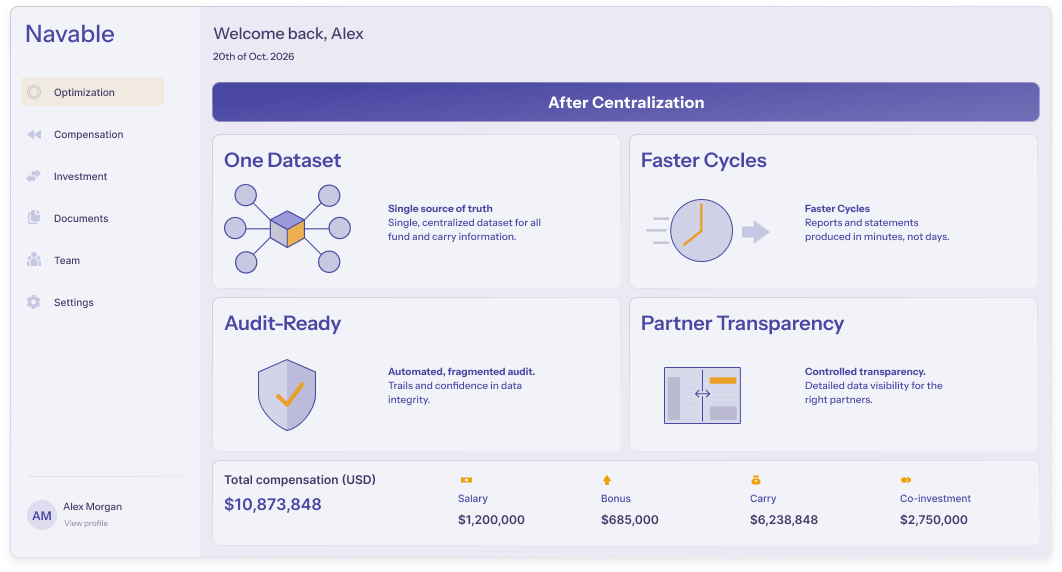
One dataset, consistent logic, repeatable outputs. Fund terms and allocation rules live centrally. Calculations are generated, not rebuilt. Definitions (vested, realized, allocated, distributed) are standardized across funds. This is the difference between modeling carry and operating carry.
Faster close and distribution cycles. Teams shorten distribution preparation and review loops into predictable processes. Fewer "we can't answer that yet" moments during the weeks you can least afford them.
Audit-ready by default. Clear change history, documented assumptions, consistent outputs tied to defined rules. That reduces audit cost, stress, and reputational risk simultaneously.
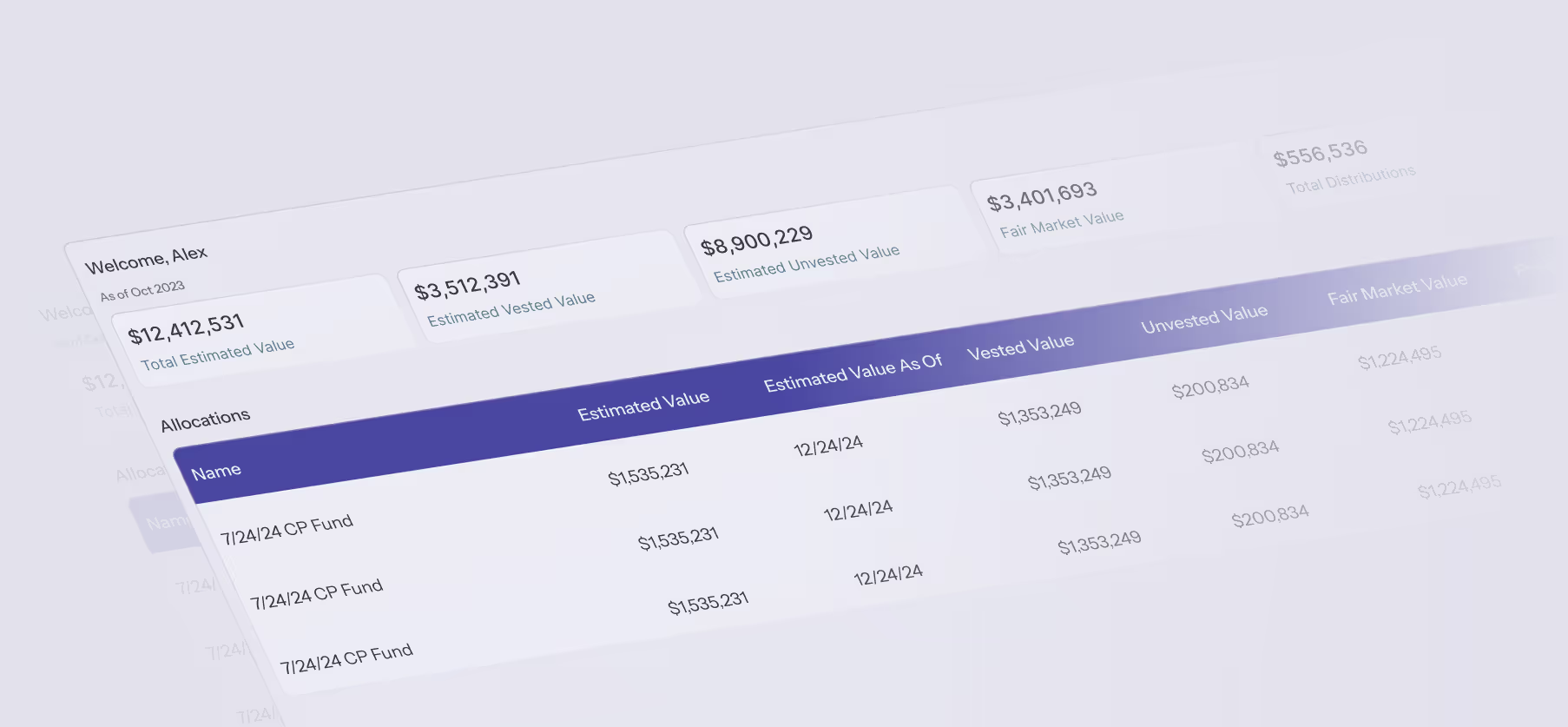
Transparency as a retention tool. Partners understand allocations without decoding a model. Employees see vesting, carry value, and total comp in one place. Finance and HR answer questions with confidence. For firms investing in retention, that clarity is a genuine competitive advantage.
What Changes on Monday Morning
Distribution run readiness. Generate allocations with consistent logic, produce review packs for partner sign-off, reduce rework from late-breaking spreadsheet changes.
Promotion and new-hire planning. Model carry grants and vesting schedules across funds, understand pool impact, avoid accidental dilution or inconsistent treatment across cohorts.
Leaver management. Standardize forfeitures, reallocations, and vesting outcomes under leaver provisions. Reduce disputes and friction when emotions are already high.
Scenario planning. Answer "what if" quickly: test fund term changes, model allocation updates, expand participation to new cohorts, compare deal-level vs. fund-level outcomes. All from the same governed dataset, without cloning workbooks.
How to Centralize Without Disrupting the Firm
The best implementations are structured and incremental.
- Inventory your carry system components. Fund terms, allocation schedules, vesting policies, historical distributions. Most firms discover more "carry logic" scattered across more places than anyone wants to admit.
- Standardize definitions. Who counts as eligible? What does "vested" mean under different leaver scenarios? What's the difference between "realized" and "distributed"? A centralized engine works best when it doesn't translate ambiguous terminology every quarter.
- Pilot with one fund. Pick something complex enough to prove value but manageable enough to migrate quickly. A single-fund pilot builds confidence and surfaces edge cases without a big-bang transition.
- Establish governance. Who can change rules and allocations? What's the approval workflow? How are exceptions documented? Centralization without governance just recreates chaos in a new location.
- Roll out stakeholder views. Partner reporting first, finance and ops workflows next, broader team transparency where retention matters. Role-based access is key.
Evaluating a Carry Engine
A checklist that reflects real operating needs:
- Handle complex carry structures and LPA terms across funds
- Support multi-fund structures with cross-fund participants
- Provide role-based access (partners vs. finance vs. employees)
- Built-in audit trails and approval workflows
- Carry award letter and document management (generation, signatures, storage)
- On-demand reporting: review packs, participant statements, management summaries
- Scenario modeling and forecasting from governed data
Navable is designed around these realities. The platform handles carry plans, allocations, vesting, co-invest, and compensation management across funds and participants, with full audit trails and a dedicated stakeholder portal. Book a demo →
From Fire Drills to Control
A centralized carry engine is a fundamentally different way of operating. Carry becomes a governed process: consistent, explainable, and scalable. Fund operations moves faster with fewer errors and less key-person risk.
For the CFO and GP, the emotional outcome matters just as much as the operational one. Fewer late nights. Fewer "where did that number come from?" conversations. More confidence going into distribution events, audits, and comp discussions.
When carry is centralized, you stop treating it like a quarterly spreadsheet project and start treating it like what it actually is: a core system of record.
If your carry process still depends on fragmented spreadsheets, Navable can help.
FAQs About Centralized Carry Engines
What is a centralized carry engine?
A system of record that applies consistent carry allocation rules across all funds and deals using a single dataset, producing repeatable calculations with a complete audit trail. It replaces fragmented spreadsheets with governed infrastructure.
Why is Excel risky for managing carried interest across multiple funds?
Version control breaks down, logic becomes inconsistent across funds, audit trails are nearly impossible to maintain, and scenario analysis requires duplicating entire workbooks. Each copy introduces new opportunities for error.
When should a firm move from spreadsheets to a carry engine?
Common triggers include launching a second or third fund, expanding carry participation beyond founding partners, managing increasingly complex LPA terms, or facing heightened audit expectations. If reconciliation consumes more time than analysis, you've likely passed the trigger point.
Can a carry engine handle both deal-by-deal and fund-level carry?
Yes. A well-built system supports fund-level (European waterfall), deal-by-deal (American waterfall), and hybrid structures by encoding the appropriate logic and tracking allocation rules, vesting, and distributions within each structure.
How long does it take to centralize carry data?
It depends on the number of funds and cleanliness of historical records. Most firms start with a single-fund pilot that can be operational within weeks. Navable's implementation typically gets firms set up in under three weeks with white-glove onboarding support.