Direct Answer
You track carry participation by employee by maintaining a participant-level record for each individual that captures their carry grants across all funds and vehicles, vesting schedules and current vesting status, any modifications (reallocations, forfeitures, transfers), and their estimated carry value — both vested and unvested. This record should be accessible to the employee through a portal or statement, and to finance and HR teams through a centralized management view.
Why Employee-Level Carry Tracking Is Growing in Importance
Carry participation is no longer limited to founding partners at most institutional-quality firms. As competitive pressure for talent has intensified, PE and VC firms increasingly grant carry to a broader set of employees — principals, VPs, operating partners, senior associates, and sometimes functional leaders in finance, IR, or operations.
This expansion is a powerful retention tool. Carry gives employees meaningful exposure to the firm's long-term performance and aligns their incentives with fund outcomes. But it also creates a significantly larger tracking burden. A firm that goes from four carry holders to forty needs infrastructure that can handle the increased volume of grants, vesting events, and status inquiries — without consuming proportionally more of the finance team's time.
The core challenge is that employees have the same need for transparency that partners do, but often receive less of it. Many firms produce partner carry statements quarterly, but employee statements are ad-hoc or annual at best. Employees may not know their current vesting percentage, their estimated carry value, or how a recent fund valuation update affected their position. That opacity creates frustration and erodes the retention value of the carry grant itself.
What Employee-Level Tracking Requires
Tracking carry for a broader participant base requires the same governance and auditability as partner-level tracking, but with additional considerations. The system needs to handle a higher volume of participants per fund, often with more standardized grant structures. Vesting schedules may be time-based, performance-based, or hybrid — and they need to be tracked individually. Forfeiture and "bad leaver" provisions are typically more consequential for employees than partners, and the exact terms need to be captured precisely. And employees at many firms benefit from seeing their carry alongside other compensation components — base salary, bonus, co-invest — in a total compensation view.
For finance and HR teams, the management view is equally important: who holds carry across which funds, what their vesting status is, how upcoming departures or promotions would affect the allocation pool, and what the firm's total carry-related compensation exposure looks like.
How Navable Helps
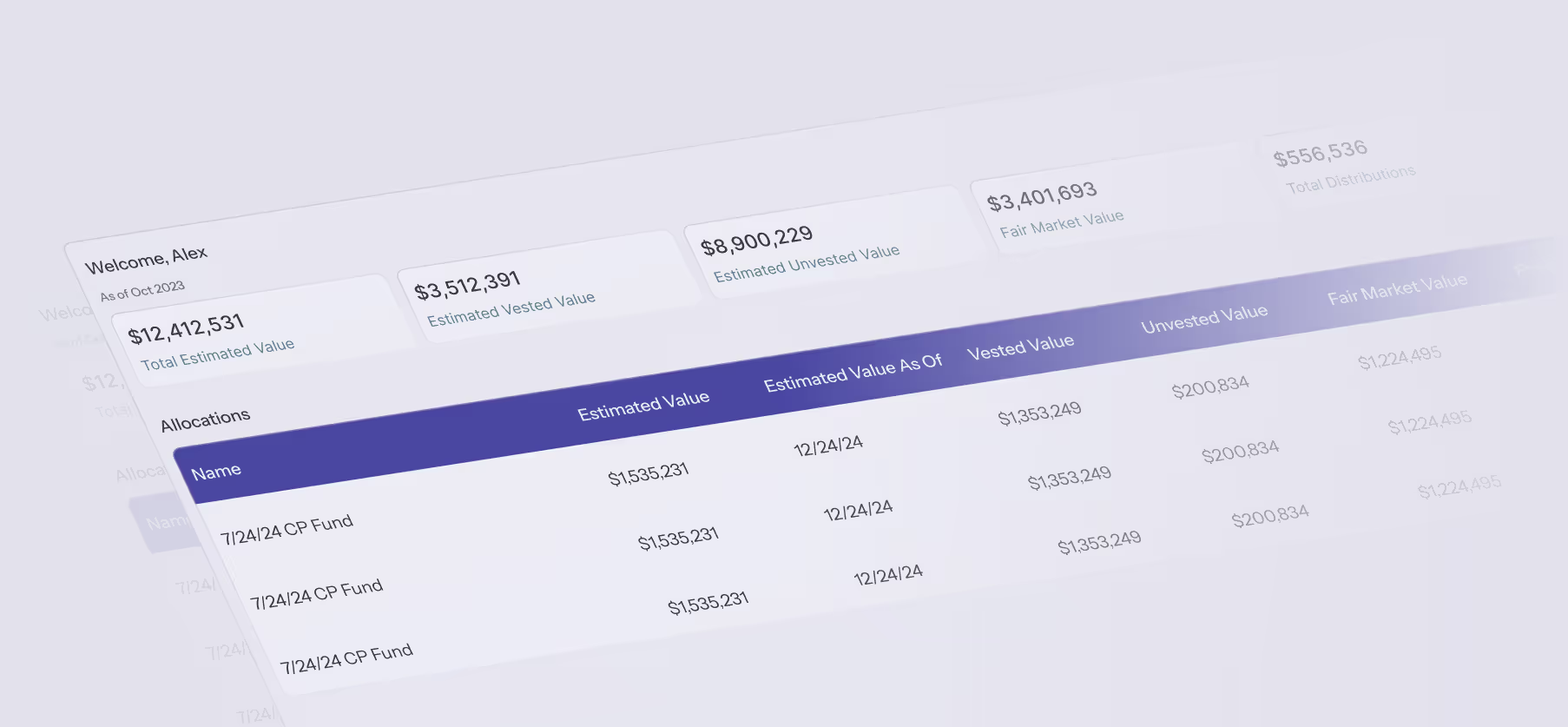
Navable tracks carry participation across every employee and partner, providing each individual with visibility into their allocations, vesting status, and estimated carry value through a dedicated portal. Finance and HR teams get a firm-wide management view that consolidates carry alongside co-invest, salary, and bonus into a total compensation picture — reducing ad-hoc reporting requests and turning carry transparency into a genuine retention tool. Book a demo →
Related Questions
- How do you track carry ownership by partner?
- What does a total compensation dashboard look like for PE?
- How do you handle carry vesting and forfeitures?
- What are carry allocation tracking best practices?
Common Questions
Should employees have visibility into their own carry data?
Yes — and increasingly, they expect it. Providing self-serve access to carry allocations, vesting schedules, and estimated values reduces the volume of ad-hoc inquiries that burden finance teams, and it reinforces the retention value of the grant by making it tangible and visible.
How do you handle carry for employees who leave before vesting?
Per the plan's forfeiture provisions, unvested carry is typically clawed back and either returned to the reserve pool or redistributed to remaining participants. The tracking system needs to process the forfeiture, update the employee's record, and adjust all downstream allocations and reporting accordingly.
Should carry and total compensation be tracked in the same system?
Ideally, yes. Carry is the largest component of long-term compensation for most GP participants. Tracking it separately from base, bonus, and co-invest means the firm can't produce a complete compensation picture without manual aggregation — which slows down comp reviews and limits the usefulness of compensation data for retention analysis.