Direct Answer
You track carry across employees and funds by maintaining a centralized system that holds every participant's allocation data — across every fund and vehicle they participate in — with the ability to report at the individual level (one person's total carry position), the fund level (one fund's full participant roster and allocation breakdown), and the firm level (aggregate carry obligations across all employees and funds). This requires a single data architecture that connects participants to funds, not separate spreadsheets per fund that have to be manually stitched together.
The Matrix Problem
Tracking carry for one employee in one fund is simple. Tracking forty employees across four fund vintages, six co-invest vehicles, and a handful of SPVs creates a matrix that spreadsheets weren't designed to manage.
Consider the data involved. Each employee holds different allocation percentages in different funds. Their vesting schedules have different start dates and may follow different structures. Some participate in co-invest alongside carry. Some hold carry in SPVs that others don't. Some joined mid-fund and only participate prospectively. Some departed and have partially forfeited portfolios that still hold vested carry from prior funds.
The matrix has two axes — participants and vehicles — and every cell contains allocation, vesting, forfeiture, and estimated value data that changes over time. The firm needs to read this matrix in both directions: "Show me everything about Employee X across all vehicles" (the compensation view) and "Show me everyone in Fund III and their current allocations" (the fund operations view). Both views need to reflect the same underlying data, updated in real time.
Why Spreadsheets Can't Hold the Matrix
In a spreadsheet environment, each fund is typically its own model. To produce a participant-level view, someone has to pull data from every fund model, standardize the format, reconcile any discrepancies, and aggregate it manually. This process takes hours, produces a snapshot that's immediately stale, and must be repeated every time the question is asked.
The inverse — pulling a fund-level view — is easier (it's one spreadsheet), but it doesn't reflect changes that may have been applied to the participant's record in another fund's model. If Employee X's allocation in Fund II was adjusted last week but Fund III's model still shows the old data, the two models are out of sync — and neither is "wrong" in isolation, but the aggregate picture is inaccurate.
This is the fundamental limitation: spreadsheets are organized by fund, but the questions the firm needs to answer are organized by participant. Bridging that gap requires manual work every single time — and the effort scales linearly with both the number of participants and the number of vehicles.
What the Right Architecture Looks Like
The solution is a data model where participants and funds are connected natively — not as separate files linked by manual aggregation. Each participant has a profile that spans all vehicles. Each fund has a participant roster connected to those profiles. Changes to a participant's data in one fund are immediately visible in every view — individual, fund-level, and firm-wide. Reporting works in both directions on demand. And the audit trail is unified, so the history of an employee's allocations across all funds lives in one place.
How Navable Helps
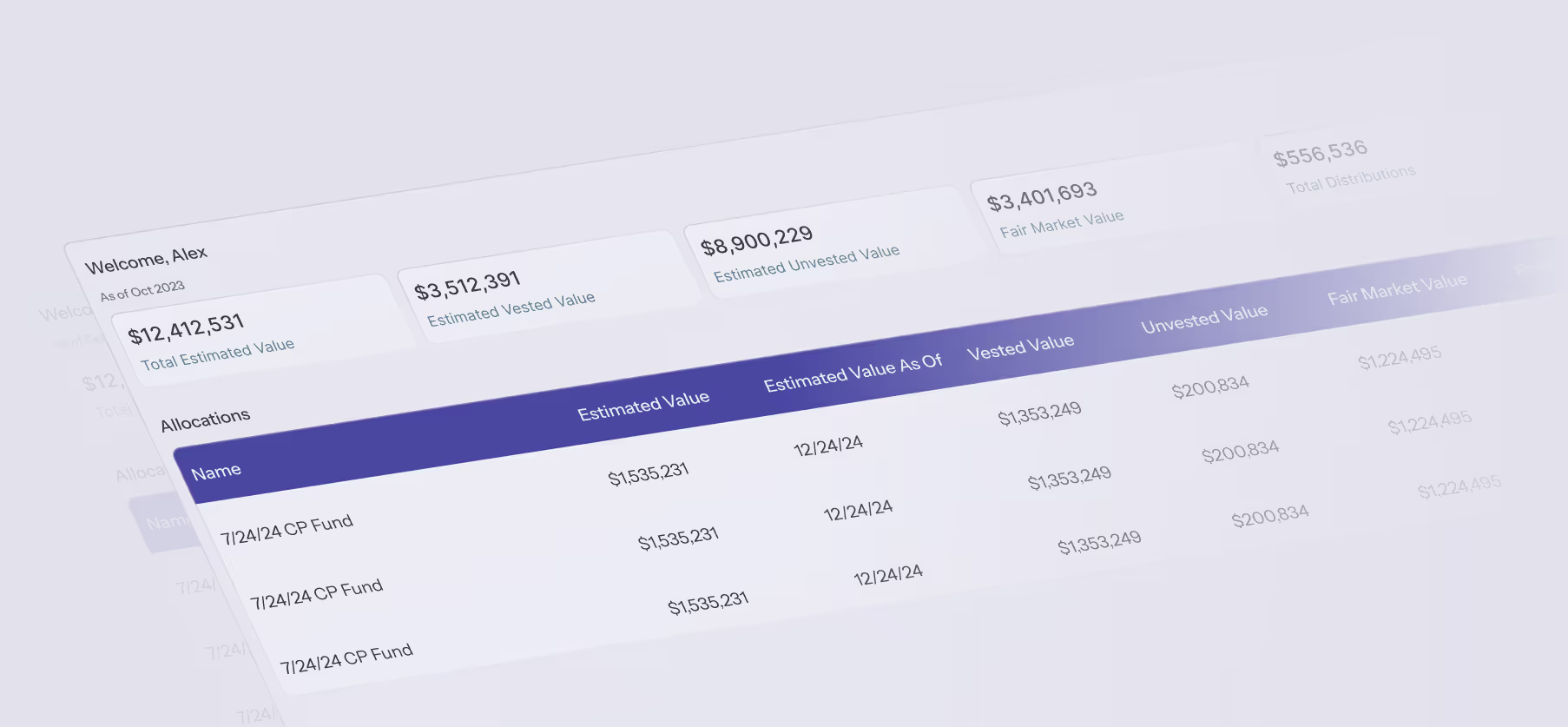
Navable is built around exactly this architecture — connecting participants to funds, vehicles, and entities in a single governed platform. Finance teams can report at the employee level, the fund level, or the firm level without manual aggregation. Employees see their total carry position across all vehicles through a dedicated portal. And every change, in any fund, is immediately reflected in every view. Book a demo →
Related Questions
- How do you track employee carry allocations?
- How do you manage carry across multiple funds?
- Carry tracking across multiple vehicles
- Carry visibility for finance teams
Common Questions
What's the most efficient way to produce a firm-wide carry report across all employees and funds?
From a centralized system that holds all the data natively. If generating a firm-wide view requires aggregating data from separate fund-level spreadsheets, the process will be slow, error-prone, and produce a snapshot that's stale by the time it's complete.
How do you handle employees who participate in some funds but not others?
The system tracks participation per fund for each employee. An employee who holds carry in Funds II and III but not Fund I has records only in the funds where they participate — but their profile still shows their complete position across the firm.
Does tracking carry across employees and funds require different tools than tracking partner carry?
Not different tools — but the system needs to scale to a larger participant base with more frequent lifecycle events (joiners, leavers, vesting milestones). The governance standards are the same; the volume and cadence of activity are higher.