Direct Answer
You track carry across multiple vehicles by maintaining each vehicle's allocation data, participant roster, and carry terms independently while providing consolidated views at the participant, fund family, and firm level. This requires a system that handles vehicle-specific economics without losing the ability to report an individual's total carry position across flagship funds, co-invest vehicles, SPVs, continuation funds, and any other carry-bearing structures.
Why Multi-Vehicle Carry Tracking Is the Norm, Not the Exception
Most institutional alternative asset firms operate more than one vehicle. A mid-size PE firm might run three flagship fund vintages, several co-invest vehicles, a continuation fund, and a handful of deal-specific SPVs. A VC platform might manage five flagship funds alongside twenty SPVs and an opportunity fund. A real estate firm might run separate funds by strategy alongside project-level JV promotes.
Each of these vehicles may carry its own carry or promote structure — with different pool sizes, different participant rosters, different hurdle rates, and different distribution mechanics. The total number of vehicles a firm manages can grow quickly, and each one adds to the tracking burden.
The challenge isn't just managing any individual vehicle's carry. It's maintaining the connections between them. A single partner may participate in eight vehicles simultaneously, with a different allocation percentage in each, different vesting schedules, and different distribution timelines. The firm needs to track all of this at the vehicle level for distributions and accounting, and at the participant level for compensation and retention.
Where Multi-Vehicle Tracking Breaks Down
The breaking point is typically the cross-vehicle question — and it comes up constantly. What's Partner X's total carry exposure across all vehicles? If we promote this principal, which vehicles does it affect? How does the firm's total carry obligation look across all active vehicles? What's the aggregate carry exposure for reporting to the board or to LPs?
When each vehicle's carry is tracked in a separate spreadsheet, answering these questions requires manual aggregation — pulling data from every file, reconciling inconsistent definitions, and hoping nothing was updated in one file and missed in another. The reconciliation time grows linearly with the number of vehicles, and the error risk grows with it.
The other common failure is vehicle-specific carry terms getting lost in the noise. When twenty vehicles are tracked across twenty spreadsheets, the unique terms of any given vehicle — a non-standard hurdle, a participant-specific side letter, a different vesting trigger — can easily be overlooked or misapplied during distributions.
What Scalable Multi-Vehicle Tracking Looks Like
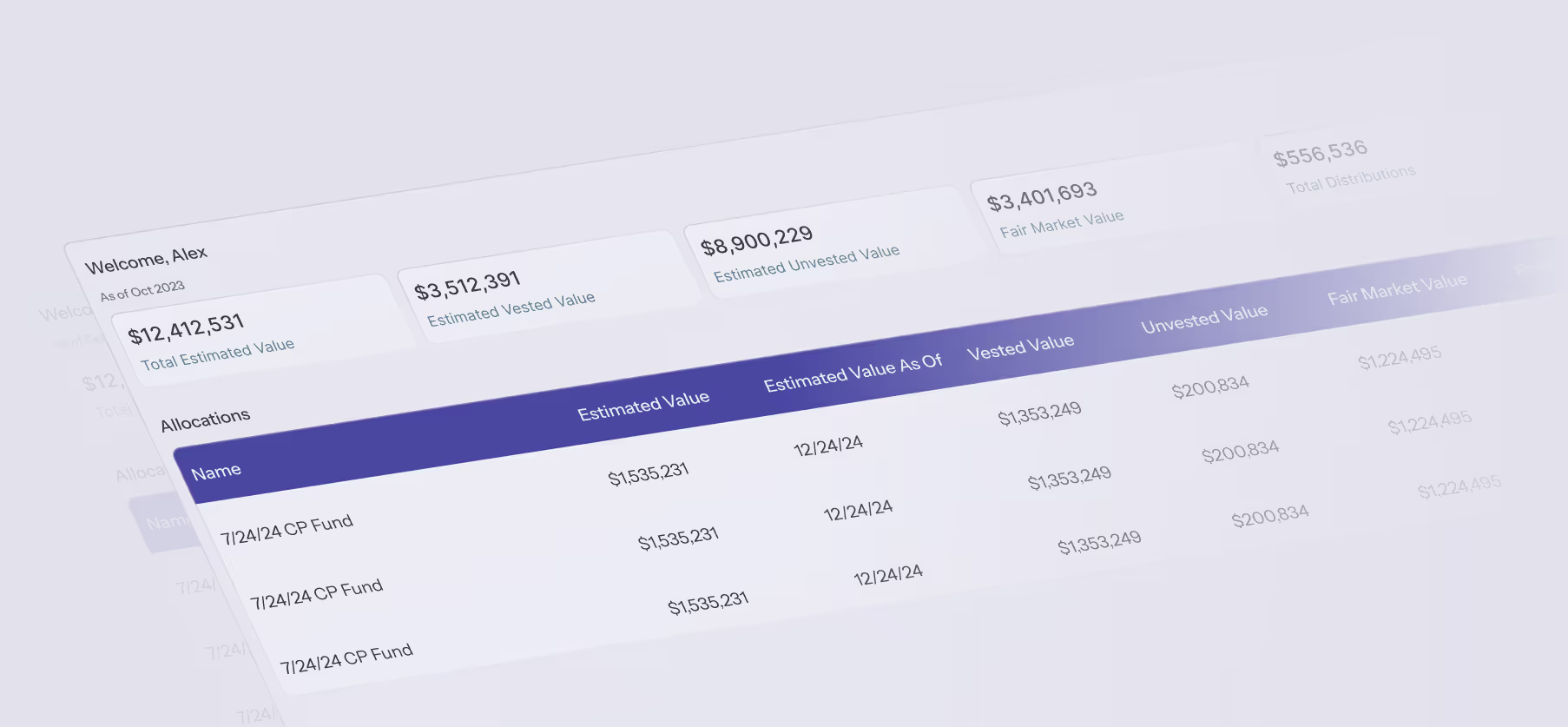
A system built for multi-vehicle carry tracking maintains each vehicle's distinct terms and participant data while providing a unified layer for cross-vehicle queries and reporting. New vehicles can be onboarded quickly (a critical requirement for firms that create SPVs on short timelines). Participant data is shared across vehicles where applicable — a partner's profile, entity information, and historical records don't need to be re-entered for every new vehicle. And reporting works at both levels: vehicle-specific detail for distributions and audits, and firm-wide consolidation for management and board-level views.
How Navable Helps
Navable tracks carry across flagship funds, co-invest vehicles, SPVs, continuation funds, and JV promotes in a single platform. Each vehicle maintains its own terms and participant roster while the system provides consolidated views at the participant and firm level. New vehicles are onboarded quickly, and the platform scales horizontally as the firm's vehicle count grows. Book a demo →
Related Questions
- How do you manage carry across SPVs?
- How do you manage carry across multiple funds?
- Managing carry data across entities
- How do VC firms track carried interest?
Common Questions
What's the difference between tracking across funds vs. across vehicles?
"Funds" typically refers to flagship fund vintages. "Vehicles" is broader — including co-invest vehicles, SPVs, continuation funds, opportunity funds, and other carry-bearing structures. Multi-vehicle tracking encompasses all of these, not just the flagship series.
How many vehicles can realistically be tracked in spreadsheets?
Most firms find that spreadsheet-based tracking becomes impractical beyond ten to fifteen active vehicles with overlapping participants. Beyond that threshold, the manual aggregation and reconciliation effort outweighs whatever flexibility spreadsheets provide.
Do co-invest vehicles and SPVs need the same level of carry tracking as flagship funds?
Yes — at the vehicle level, every carry-bearing structure needs accurate allocation data, audit trails, and distribution-ready records. The tracking depth per vehicle may be simpler (fewer participants, simpler terms), but the governance standards should be equivalent.