Direct Answer
The carry reporting process in private equity involves producing accurate, consistent reports for multiple audiences — partners, employees, firm leadership, LPs, and auditors — that show carry allocations, vesting status, estimated values, and distribution history. Effective carry reporting is generated directly from the firm's carry system of record, ensures internal and external outputs reconcile, and is produced on a defined cadence with the ability to respond to ad-hoc requests.
Who Needs Carry Reports and What They Need to See
Carry reporting isn't one report — it's a set of outputs tailored to different audiences, each with different needs and different levels of detail.
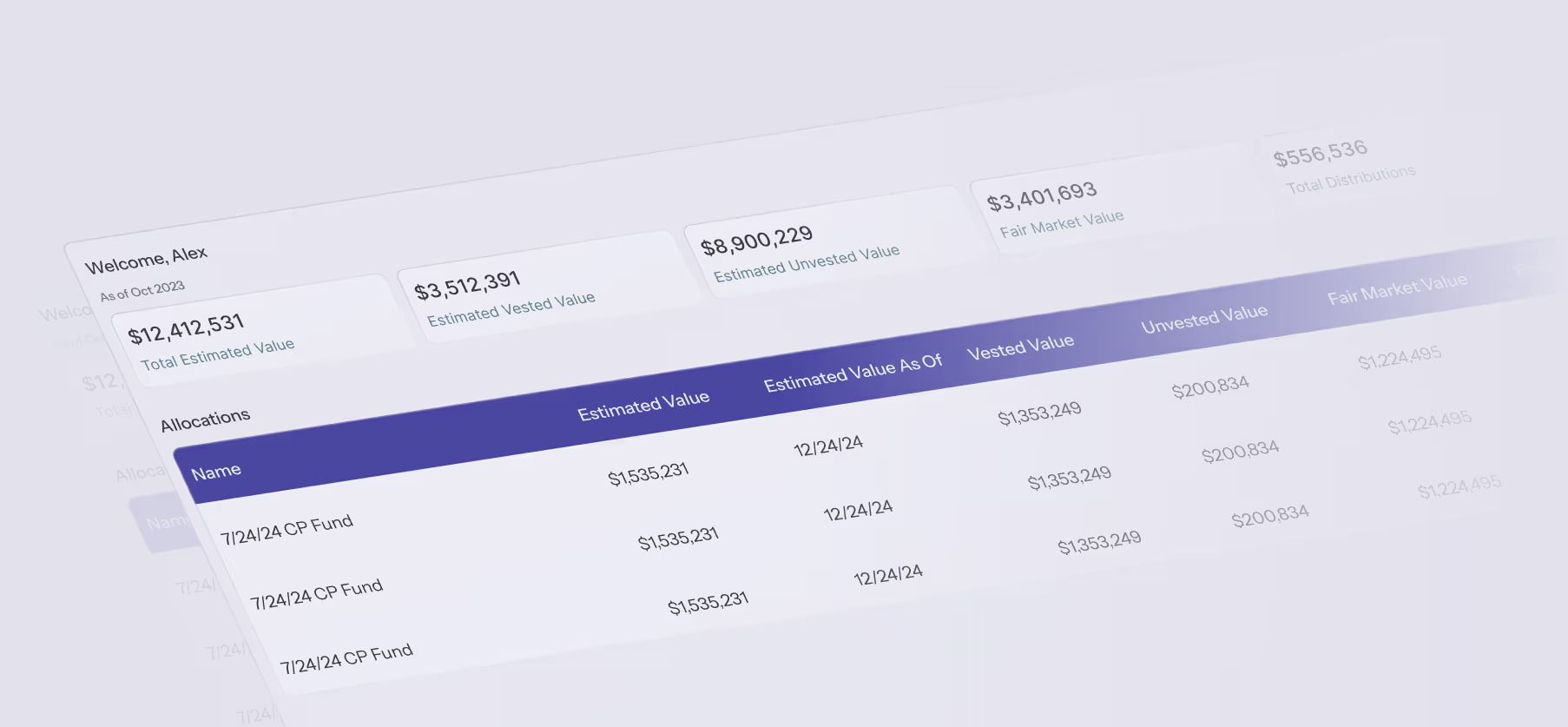
Partners and carry holders need individual statements showing their allocation percentages by fund, vesting status and schedule, estimated carry value (vested and unvested), distribution history, and any changes since the last reporting period. These statements are the most sensitive output the firm produces — and the one where errors create the most immediate friction.
Firm leadership and boards need aggregate views: total carry obligations across funds, how the carry pool is allocated, the impact of recent changes (hires, departures, rebalancing), and projections for future distributions. This is the data that drives compensation planning and strategic decisions.
LPs need transparency into how carry is structured and earned, typically at the fund level. They want to understand the waterfall mechanics, the GP's aggregate participation, and how carry relates to fund performance and distributions.
Auditors need everything: the full history of allocations, the documentation supporting each change, the vesting records, and the connection between allocation data and distribution calculations. Audit-ready reporting isn't a separate process — it's the byproduct of maintaining governed carry data throughout the year.
Why Reporting Is Where Data Problems Surface
Reporting is the moment of truth for carry data quality. If allocations are inconsistent, if vesting records are stale, if changes weren't documented properly — those gaps become visible when the firm tries to produce accurate outputs for any of the audiences above.
The most common reporting failures involve inconsistency between what partners see in their statements and what leadership sees in the firm-wide rollup (because the data was pulled from different sources), delays in producing reports because the data requires manual assembly and reconciliation before it's presentable, and inability to respond quickly to ad-hoc requests from LPs or auditors because the data isn't centralized or queryable.
What Good Carry Reporting Requires
The operational principle is straightforward: every carry report should be generated from the same governed data source. When partner statements, management summaries, LP reports, and audit documentation all draw from the same system of record — with no manual assembly step in between — consistency is structural, not aspirational. The reporting process becomes a generation step, not a reconciliation exercise.
How Navable Helps
Navable generates carry reports for every audience — partner statements, firm-wide summaries, and audit documentation — directly from its centralized system of record. Reports are produced on demand, ensuring consistency across all outputs without manual assembly or reconciliation. Partners and employees access their own data through a dedicated portal, reducing the ad-hoc reporting burden on finance teams. Book a demo →
Related Questions
- How do you manage carry reporting for LPs?
- The carry allocation workflow in private equity
- How do you track carry ownership by partner?
- Tracking carry participation by employee
Common Questions
How often should carry reports be produced?
Partner and employee statements are typically quarterly. Leadership and board-level reporting may be quarterly or semi-annual. LP reporting aligns with the fund's reporting schedule. Audit documentation should be available on demand, not produced retroactively.
What's the most common carry reporting mistake?
Producing reports from a different data source than what drives distributions. When participant statements show one set of numbers and the distribution model uses another, the resulting inconsistency damages trust and creates audit risk.
Should partners have self-serve access to carry data?
Yes. Partner portals that provide real-time access to allocations, vesting, and carry value reduce ad-hoc reporting requests, improve transparency, and shift the finance team's time from report production to analysis and decision support.