Direct Answer
You manage employee co-invest and carry together by tracking both programs in a single system that maintains each participant's carry allocations, co-invest commitments, capital call and distribution activity, and total economic exposure across all funds and vehicles. The goal is a unified view of each employee's total incentive position — so the firm can plan compensation holistically and each participant can see their full upside in one place.
Why Carry and Co-Invest Need to Be Managed Together
Carry and co-invest are distinct programs with different mechanics — carry is a profit share tied to fund performance, while co-invest is an employee's own capital committed alongside the fund. But from a compensation and retention perspective, they're deeply connected. Together, they represent an employee's total long-term economic alignment with the firm's outcomes.
The problem is that most firms track them separately. Carry allocations live in one model (or set of spreadsheets), managed by the CFO or controller. Co-invest commitments, capital calls, and distributions live in another — sometimes managed by fund ops, sometimes by HR, sometimes in a fund admin's system. The result is that nobody has a complete picture of any individual participant's total position without manually stitching together data from multiple sources.
This fragmentation creates three specific problems. First, the firm can't answer the fundamental retention question: "What is this employee's total economic exposure to our funds?" Without that number, compensation discussions are incomplete and recruiting conversations lack specificity. Second, employees themselves can't see their total position. They may receive quarterly carry statements from one source and co-invest capital account statements from another, with no integrated view that shows them what everything adds up to. Third, the finance team spends disproportionate time manually aggregating data across systems when leadership asks for a consolidated compensation view — during year-end reviews, promotion discussions, or board reporting.
What Integrated Management Looks Like
Managing carry and co-invest together doesn't mean merging the underlying program mechanics. Carry and co-invest still have separate allocation rules, separate accounting treatment, and separate distribution waterfalls. What it means is tracking both in one system that understands the relationship between them.
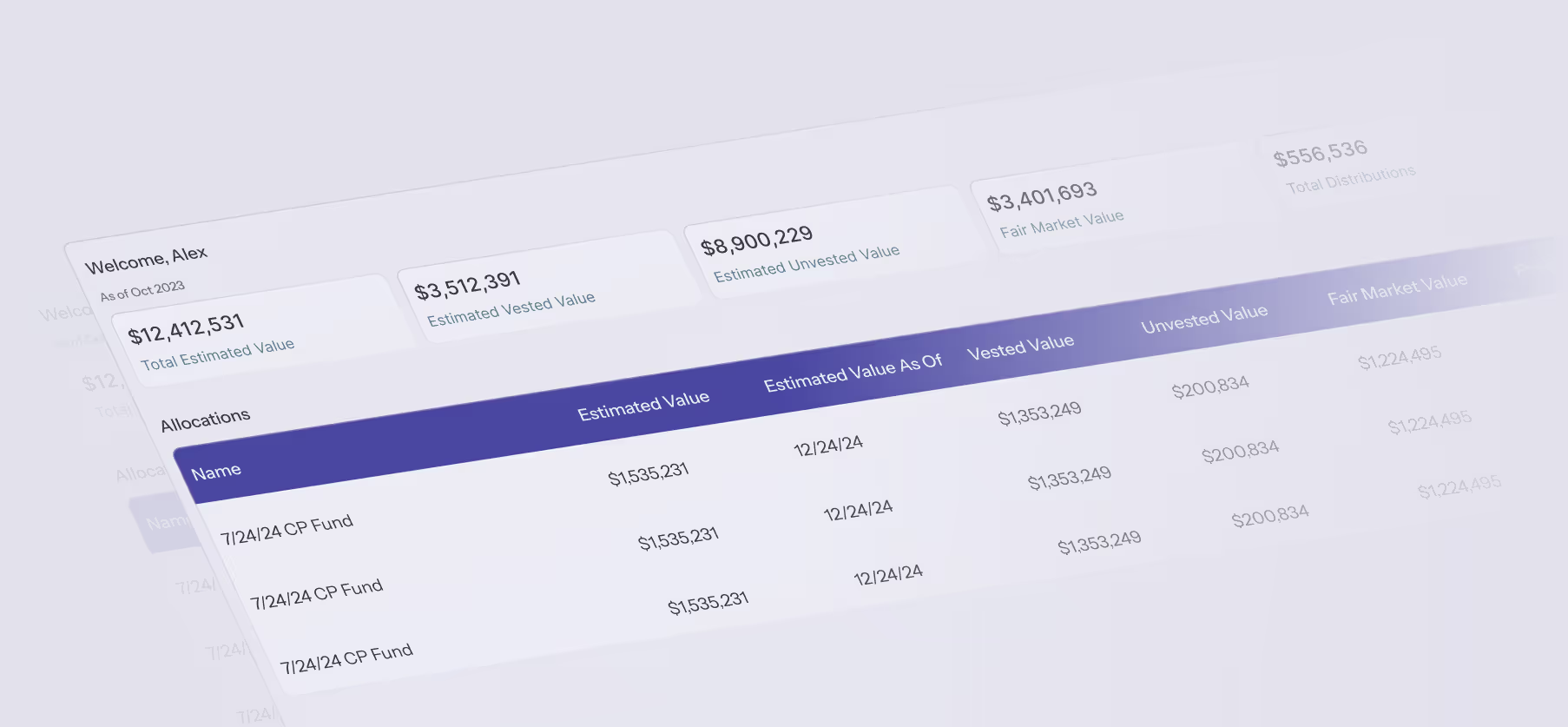
Each participant should have a single profile that shows their carry allocations (by fund, with vesting status and estimated value), their co-invest commitments (by fund, with capital called, distributed, and remaining), their GP commit obligations (if applicable), and their total estimated incentive position across all programs and vehicles.
The system should also support the operational workflows unique to each program — election windows and commitment tracking for co-invest, vesting and forfeiture administration for carry — while providing the consolidated reporting layer that ties everything together.
How Navable Helps
Navable manages both carry and employee co-invest in a single platform — tracking allocations, commitments, capital activity, vesting, and total compensation across all funds and vehicles. Employees see their complete economic position through a dedicated portal that combines carry value, co-invest performance, and other compensation components in one view. Finance teams get the consolidated data they need for comp planning without manual aggregation. Book a demo →
Related Questions
- How do you track employee carry allocations?
- Tracking carry participation by employee
- Carry visibility for finance teams
- How do you manage carry across multiple funds?
Common Questions
Should carry and co-invest statements be combined or separate?
Both. Participants benefit from seeing their total position in a combined view (for understanding overall incentive alignment), but they also need the program-level detail (carry allocation vs. co-invest capital account) for their own financial and tax planning.
Who typically manages co-invest programs?
It varies — CFO, fund operations, or HR may own different aspects. The operational challenge is that regardless of who manages each program, the reporting needs to come together. A unified platform eliminates the handoff and aggregation steps that create gaps.
How do co-invest programs affect carry tracking?
Co-invest returns are distinct from carry returns, but participants often hold both in the same fund. The system needs to track and report them separately while providing a consolidated view — so participants and leadership can understand the total economic picture without confusing the two income streams.