Direct Answer
You manage carry splits across deals and funds by maintaining allocation records at the appropriate level of granularity — fund-level, deal-level, or both — and tracking how each participant's split varies across vehicles and investments. This requires a system that can hold different allocation percentages per participant per deal within the same fund, reconcile deal-level splits back to the fund-level carry pool, and produce reporting at both levels.
Where Carry Splits Get Complex
In a simple fund-level carry structure, every participant holds the same percentage across all deals — and tracking is straightforward. The complexity escalates when firms introduce deal-level participation, where different team members hold different percentages on different deals within the same fund.
This is common in firms that use "jump-ball" or deal-team carry, where the partner who sourced and led a deal receives a higher allocation on that specific investment. It's also common in multi-strategy platforms where different investment teams work on different deals, and in firms that grant deal-level carry to operating partners or advisors who contribute to specific portfolio companies.
The result is a matrix of allocations: Partner A holds 12% carry at the fund level but 18% on Deal X (which they led) and 8% on Deal Y (where they played a supporting role). Partner B holds the inverse. And when a distribution event occurs for a specific deal, the system needs to apply the deal-level split — not the fund-level split — to determine each participant's payout.
The tracking challenge compounds across multiple funds. A participant's deal-level carry in Fund II may look completely different from their deal-level carry in Fund III — different deals, different splits, different co-participants. And if the firm also runs co-invest vehicles with their own carry or promote structures, each of those needs to be tracked and reconciled independently.
Where Errors Typically Occur
The most common failure is applying the wrong split level during a distribution. When fund-level and deal-level allocations coexist in the same spreadsheet, it's easy to accidentally apply the fund-level percentage to a deal-level distribution — or vice versa. The second most common failure is inconsistency between what's tracked in the allocation model and what the distribution model actually uses. If these are maintained in separate files, misalignment is almost guaranteed to surface eventually.
The reconciliation burden also grows non-linearly. Each deal adds another row in the allocation matrix, and each participant-deal combination needs to be tracked, reported, and potentially adjusted as roles evolve during the hold period.
How Navable Helps
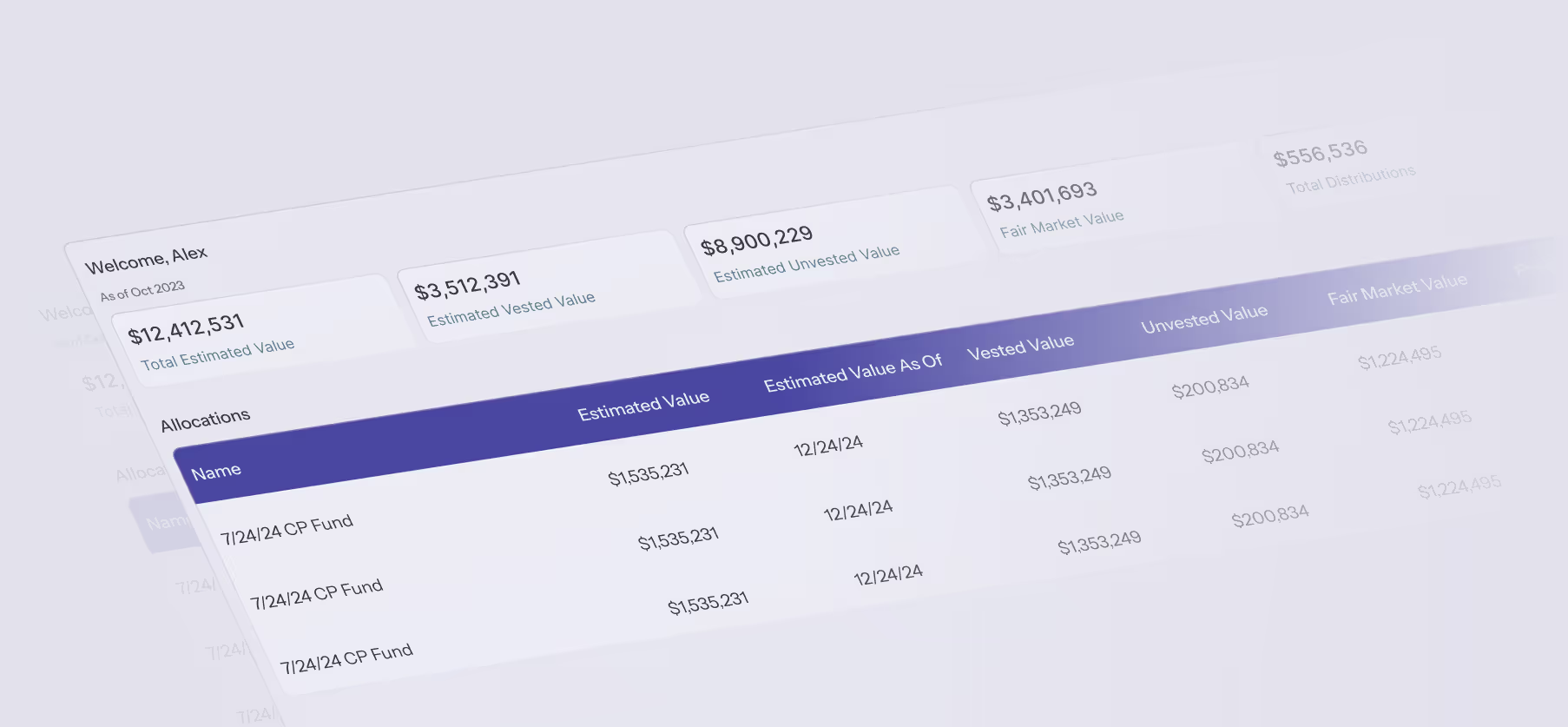
Navable tracks carry allocations at both the fund level and deal level, maintaining the full matrix of participant-by-deal splits across every vehicle. Reporting works at both levels — fund-wide rollups for management and deal-level detail for distributions — and allocation data flows directly into distribution workflows without manual bridging between models. Book a demo →
Related Questions
- How do you manage carry across multiple funds?
- How do you track carry ownership by partner?
- How do you manage carry across SPVs?
- What are carry allocation tracking best practices?
Common Questions
What's the difference between fund-level and deal-level carry splits?
Fund-level splits assign each participant the same allocation percentage across all deals. Deal-level splits allow percentages to vary by investment, typically reflecting who sourced, led, or actively managed each deal.
Can a firm use both fund-level and deal-level carry in the same fund?
Yes — many firms use a hybrid approach. A base allocation is set at the fund level, with an incremental deal-level component for the lead partner or deal team. This creates two layers that need to be tracked and reconciled together.
How do deal-level carry splits affect distributions?
When a specific deal exits or generates a distribution, the deal-level split determines each participant's share of that payout — not their fund-level percentage. The tracking system must apply the correct split per event to ensure accurate distributions.