Direct Answer
You manage carry dilution by establishing clear rules, defined in the fund's carry plan, for how new grants reduce existing participants' allocations, whether dilution is pro rata or targeted, and whether a reserve pool absorbs new allocations before any dilution occurs. Each dilution event should be tracked as a discrete change, with before-and-after records and full documentation, across every affected fund and participant.
What Carry Dilution Actually Means in Practice
Carry dilution occurs whenever a new participant is granted carry from a fixed pool, reducing the percentage held by existing participants. It's the carry equivalent of equity dilution — the total pie stays the same size, but each participant's slice gets smaller.
This happens most commonly when a firm hires a new partner or senior professional and grants them carry from the existing fund, promotes an internal team member into carry participation, or brings in an operating partner, venture partner, or advisor with a carry grant.
In well-structured plans, the firm sets aside a reserve pool at fund formation — typically 5–15% of total carry — specifically to absorb future grants without diluting existing holders. But reserves eventually get consumed, and many firms (especially earlier in their lifecycle) don't set aside enough. When the reserve runs out, new grants have to come from somewhere — and that means diluting existing participants.
Why Dilution Is Operationally Sensitive
Carry dilution isn't just a math problem. It's a people problem. Existing partners who built the fund's track record don't react well to seeing their allocation shrink — especially if the dilution mechanism isn't clearly defined in advance or if they learn about it after the fact.
The operational challenge is equally significant. When a new grant dilutes existing allocations, every participant's percentage changes. That change needs to flow through to allocation records, vesting schedules, distribution models, partner statements, and total compensation reporting — across every affected fund. If the firm manages multiple vintages with overlapping participants, a single dilution event in Fund III may need to be reconciled against unchanged allocations in Funds I and II. Without a centralized system, ensuring consistency across all of these outputs is a manual, error-prone process.
The other common issue is dilution that was supposed to come from the reserve but accidentally reduces existing participants' allocations — or vice versa. When the mechanics aren't tracked precisely, the source of the dilution becomes ambiguous, creating confusion that's difficult to unwind.
How Navable Helps
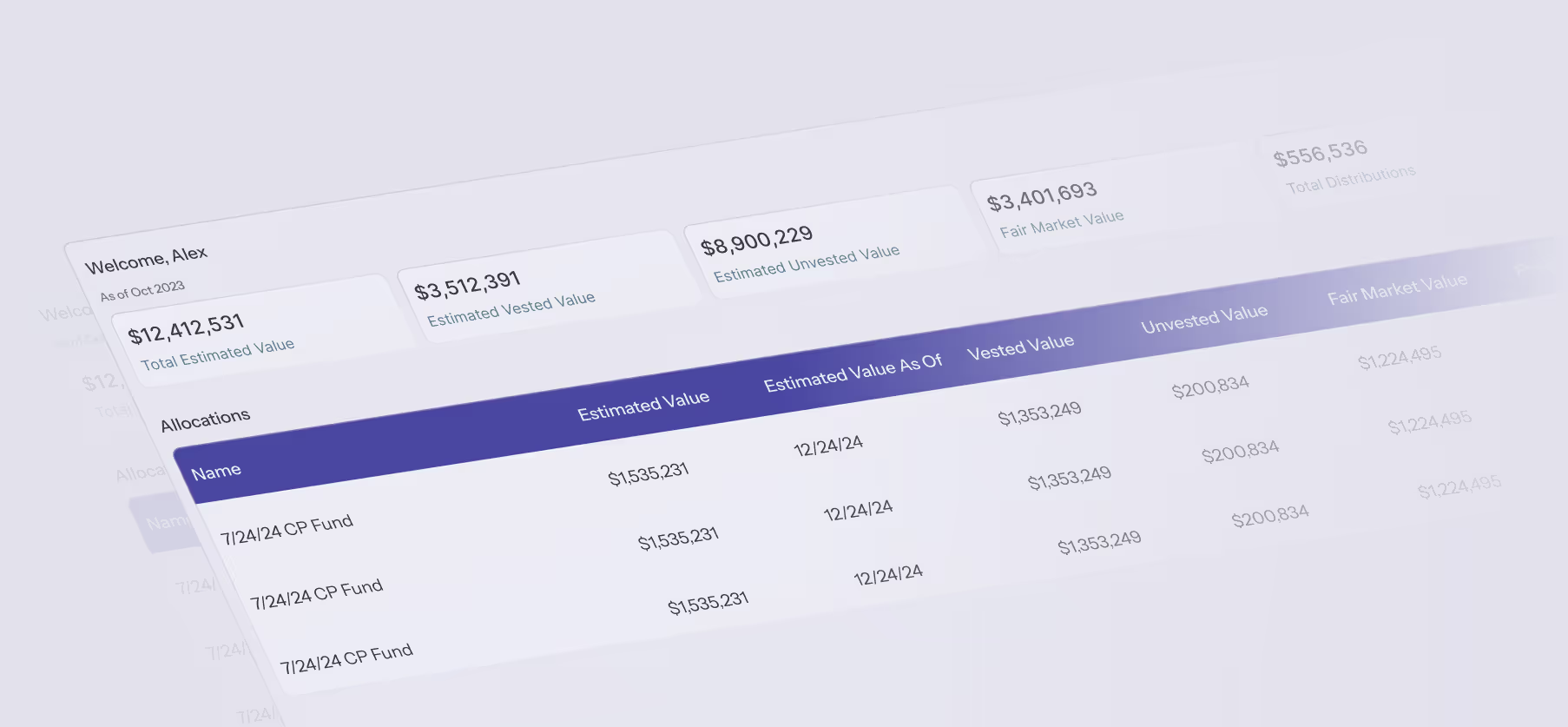
Navable tracks carry dilution as a structured event — recording the source of the new allocation (reserve or dilution), the impact on every affected participant, and the before-and-after state with full audit documentation. Changes flow automatically across funds and reporting, eliminating the manual reconciliation that makes dilution events error-prone and time-consuming. Book a demo →
Related Questions
- How do you allocate carry to new partners?
- Carry allocation adjustments in private equity
- How do you manage carry across multiple funds?
- How do you track carry ownership by partner?
Common Questions
What's the difference between dilution from reserves and dilution from existing allocations?
Reserve dilution reduces the unallocated pool without affecting current participants' percentages. Existing allocation dilution reduces every current participant's share (pro rata or targeted) to make room for the new grant. The distinction matters enormously for partner relations and needs to be tracked precisely.
How do you prevent unexpected carry dilution?
Define the dilution mechanism in the carry plan upfront — including what happens when the reserve is exhausted. Communicate clearly before changes take effect. And track every dilution event with full documentation so there's no ambiguity about what happened and why.
Can dilution be structured differently across funds?
Yes. Each fund's carry plan can define its own dilution rules. A firm might use pro rata dilution in Fund II but targeted dilution in Fund III. The tracking system needs to handle each fund's terms independently while still providing a consolidated view for each participant.