Direct Answer
You manage carry data across entities by maintaining a centralized system that tracks allocations, vesting, and ownership at the entity level — capturing how carry flows through the GP entity structure (management companies, carry vehicles, holding entities, trusts) and mapping each participant's economic interest back through the relevant entities to their individual record. This requires a system that understands multi-entity relationships, not just participant-level allocations.
Why Entity-Level Carry Tracking Matters
Carry doesn't flow directly from a fund to an individual. It flows through a chain of entities — typically from the fund to a GP entity, from the GP entity to a carry vehicle, and from the carry vehicle to individual participants (who may themselves hold through personal trusts, LLCs, or other structures).
Each entity in that chain has its own allocation logic, its own accounting requirements, and potentially its own distribute-or-retain decisions. A partner who holds 10% of the carry vehicle doesn't necessarily receive 10% of every distribution — entity-level expenses, tax reserves, management company offsets, and GP commitment obligations may all affect the final amount.
For the finance team, this means carry tracking isn't just about "who holds what percentage." It's about understanding how carry flows through the entity structure, where retain/distribute decisions are made, and how each participant's economic interest maps through potentially multiple layers of entities.
Where Entity-Level Complexity Creates Problems
The most common issues arise when carry is tracked at the individual level but the entity relationships aren't explicitly modeled. A partner's carry percentage and their actual economic interest can diverge when entity-level adjustments (expenses, reserves, offsets) are applied. Distributions calculated at the carry vehicle level don't automatically translate to individual payouts without entity-level accounting. Tax reporting (K-1s) needs to reflect the correct entity — not just the correct amount — which requires precise mapping of participants to their holding structures.
When these relationships are managed through notes, side calculations, or implicit knowledge, the reconciliation required to produce accurate distributions, statements, and tax documents becomes an exercise in manual data assembly — and every cycle carries the risk of a broken link in the chain.
What Entity-Aware Carry Tracking Requires
A system that handles carry across entities needs to model the relationships between fund entities, GP entities, carry vehicles, and individual holders. It should track allocations at each level of the hierarchy, propagate changes through the chain when upstream or downstream modifications occur, and produce reporting that reflects both the entity-level view (for accounting and tax) and the individual-level view (for participant statements and compensation).
How Navable Helps
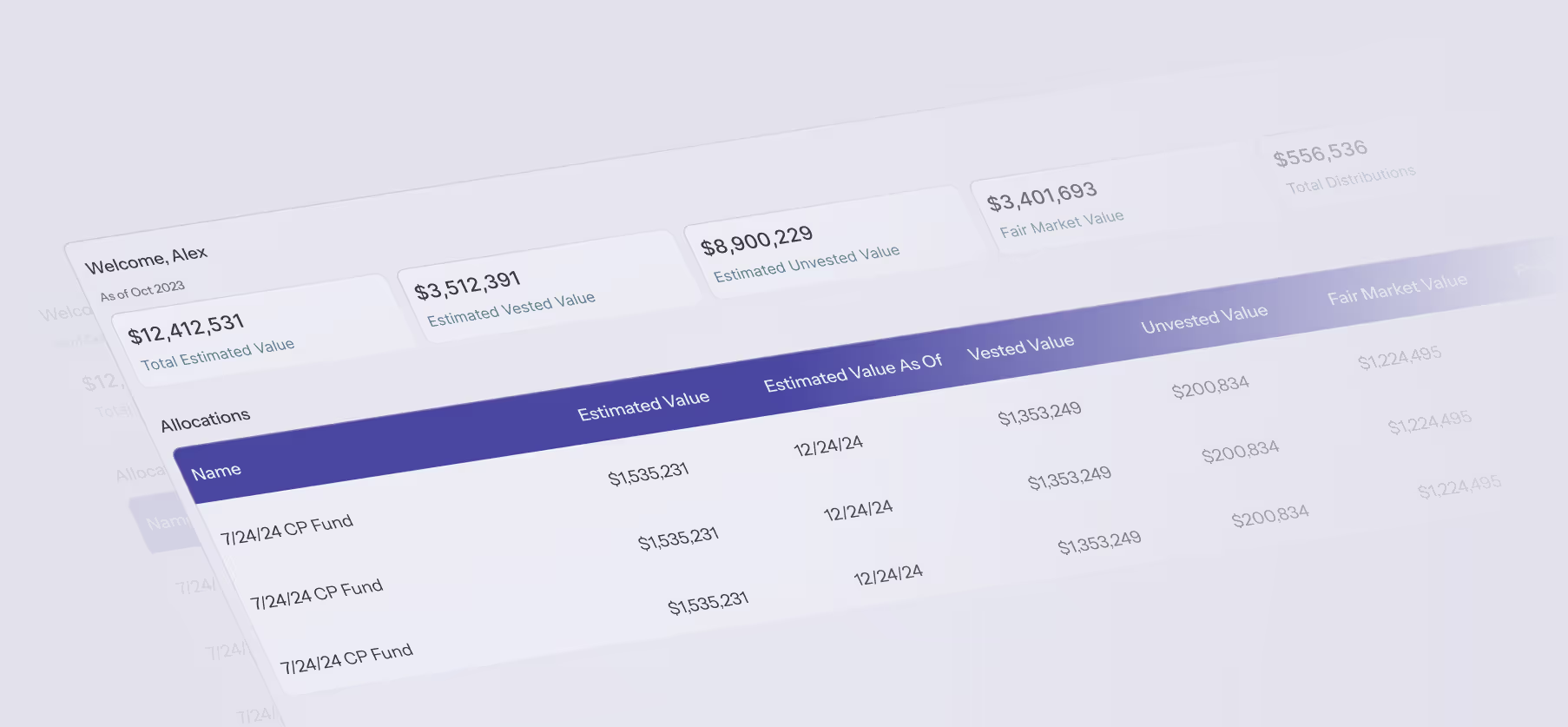
Navable tracks carry across the full entity structure — from fund to GP entity to carry vehicle to individual participants and their holding structures. The platform models multi-entity relationships and propagates allocation changes through every layer, ensuring that distributions, statements, and tax reporting all reflect the correct entity-level economics. Book a demo →
Related Questions
- How do you manage carry across multiple funds?
- How do you manage carry across SPVs?
- How do you track carry ownership by partner?
- How do you centralize carry data across funds?
Common Questions
How many entities are typically involved in a PE firm's carry structure?
It varies, but a mid-size PE firm may have a management company, one or more GP entities, a carry vehicle per fund, and individual participants holding through personal trusts or LLCs. Larger firms may have dozens of entities in the chain. Each one needs to be accounted for in carry tracking.
Does carry tracking software need to handle entity-level accounting?
It needs to model entity relationships and track allocations at each level — but it doesn't need to replace the fund's general ledger or accounting system. The carry platform and the accounting system should share data, with the carry platform providing the allocation detail that feeds entity-level accounting entries.
How do participant trusts and holding entities affect carry tracking?
When a participant holds carry through a personal entity rather than in their own name, the tracking system needs to map the economic interest to the correct holding structure. This affects distribution routing, tax reporting, and statement generation — and the mapping needs to be captured in the system, not maintained informally.