Direct Answer
You track employee carry allocations by maintaining a participant-level record for each carry holder — including allocation percentages, vesting schedules, fund participation, forfeiture provisions, and change history — in a centralized system that scales across a larger participant base than the traditional partner group. As firms extend carry beyond founding partners to principals, VPs, operating partners, and other employees, the tracking infrastructure needs to handle higher volume, more standardized grant structures, and greater demand for transparency.
Why Employee Carry Tracking Is a Different Problem Than Partner Carry
Tracking carry for four founding partners is a contained exercise. Tracking carry for forty employees across multiple fund vintages is an operational discipline that requires fundamentally different infrastructure.
The grants themselves tend to be more standardized — most employees receive carry under a templated plan with defined vesting schedules, forfeiture terms, and allocation tiers based on seniority. But what's gained in structural simplicity is offset by volume and lifecycle complexity. More participants means more vesting events to track, more joiner and leaver activity, more forfeiture calculations, more reallocation events, and more people expecting accurate, timely visibility into what they hold.
The other distinction is the audience. Partners typically have direct access to the CFO or controller when they have carry questions. Employees don't — and shouldn't need to. They need a self-serve way to understand their allocations, monitor their vesting, and see what their carry is estimated to be worth. Without that, the finance team absorbs every inquiry manually, and the carry grant's value as a retention tool diminishes because it feels opaque.
Where Employee Carry Tracking Goes Wrong
The most common failure is tracking employees in the same ad-hoc way the firm tracks partners — individual entries in a fund-level spreadsheet, with vesting updates applied manually and no structured way for employees to see their own data.
This creates three recurring problems. First, vesting events get missed or delayed. When a VP's carry vests on their three-year anniversary and the update requires someone to manually recalculate and apply the change across two fund models, it's easy for the milestone to slip — especially when the finance team is focused on distribution preparation or year-end close.
Second, leaver processing becomes chaotic. Employee departures happen more frequently than partner departures, and each one triggers forfeiture calculations, reallocation decisions, and documentation requirements. When these are handled through ad-hoc spreadsheet edits, inconsistencies accumulate.
Third, the firm can't produce employee carry statements at scale. If generating a single participant's statement requires pulling data from multiple files and manually formatting it, producing statements for forty carry holders every quarter becomes a significant time sink — and most firms simply don't do it, leaving employees in the dark.
What Scalable Employee Carry Tracking Looks Like
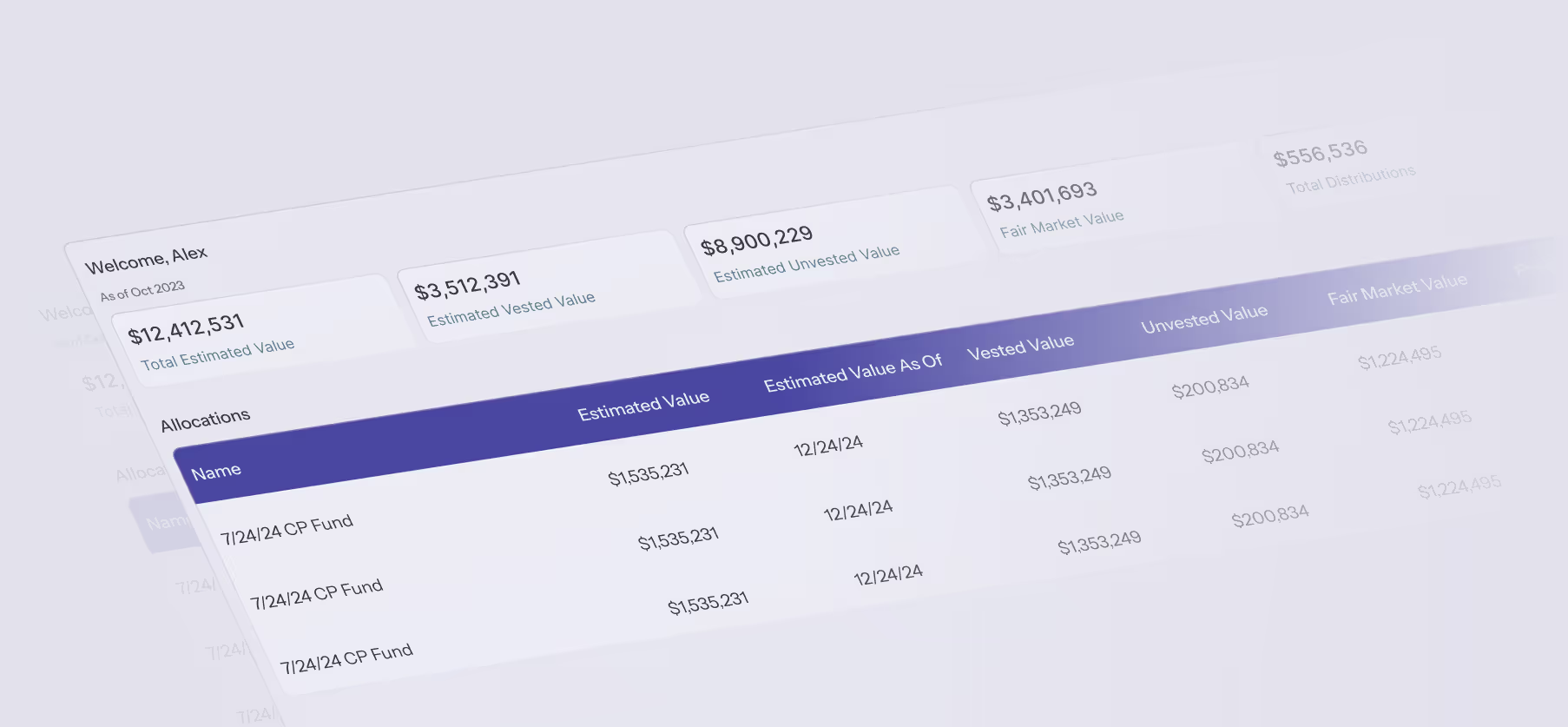
The right approach handles employee carry with the same governance and auditability as partner carry, but with infrastructure designed for higher volume. That means templated grant structures that can be applied to new hires efficiently, automated vesting administration that tracks milestones and updates status without manual intervention, standardized forfeiture and reallocation workflows for departures, and a self-serve employee portal that provides each participant with real-time visibility into their allocations, vesting, and estimated carry value.
How Navable Helps
Navable tracks employee carry allocations across funds and vehicles with the same governance applied to partner carry — vesting administration, forfeiture processing, change tracking, and audit trails. Employees access their allocations, vesting status, and estimated carry value through a dedicated portal, reducing ad-hoc inquiries and making carry tangible as a retention tool. Finance teams manage the broader participant base without proportionally increasing their workload. Book a demo →
Related Questions
- Tracking carry participation by employee
- Managing employee co-invest and carry together
- Carry vesting tracking software
- How do you track carry ownership by partner?
Common Questions
At what point should a firm formalize employee carry tracking?
As soon as carry participants exceed the founding partner group. Once you have ten or more carry holders — each with independent vesting schedules, participating across multiple funds — spreadsheet-based tracking creates material operational risk and an unsustainable reporting burden.
Should employee carry statements include estimated values?
Yes. Showing employees only their allocation percentage without an estimated value makes carry feel abstract. Including estimated vested and unvested values (with appropriate disclaimers about unrealized estimates) makes the grant tangible and reinforces its retention value.
How do you handle carry for employees in different jurisdictions?
Multi-jurisdiction employees may have different tax treatment, currency exposure, and regulatory considerations affecting their carry. The tracking system should capture jurisdiction-specific attributes alongside allocation data so that statements and tax reporting reflect the correct treatment. Navable supports employee co-invest and carry management across 20+ countries.