Direct Answer
You simulate carry outcomes by applying hypothetical performance, allocation, or structural changes to your current carry data and evaluating the resulting impact on individual participant payouts, pool utilization, and firm-wide economics. Carry simulations allow leadership to test decisions before making them — evaluating options like new grants, departures, performance scenarios, or plan design changes in a controlled environment that doesn't alter live records.
What Carry Simulations Are Used For
Simulations are the analytical layer between "we're considering this" and "we've decided." They answer questions that require manipulating carry data in ways that haven't happened yet — and they're used far more frequently than most firms' tools can easily support.
Hiring and retention decisions. How does a carry grant at 3% vs. 5% affect the pool? What's the projected value to the hire under base and upside performance? How does the dilution hit existing participants? These questions need answers before an offer letter is drafted — and they need to be modeled against current, accurate allocation data.
Departure planning. If a senior partner announces their retirement in 18 months, what happens to their carry? How does the forfeiture and reallocation play out across funds? What's the impact on the remaining partner group? Simulating the departure before it happens gives leadership time to plan rather than react.
Fund design. Before launching a new fund, the firm needs to model carry pool sizing, initial allocations, reserve pools, and vesting terms — testing different configurations against expected performance to ensure the economics work for both the firm and the participants.
Performance sensitivity. What do carry payouts look like if Fund III returns 1.5x vs. 2.0x vs. 2.5x? How does that change the distribution timeline? Which participants benefit most from the upside, and how exposed is the firm to clawback in the downside case?
Why Simulations Need a Governed Baseline
The quality of any simulation depends entirely on the accuracy of the starting point. If the current allocation data is stale, if vesting records haven't been updated, or if recent changes haven't been applied, the simulation produces outputs that feel analytical but are grounded in wrong data.
This is the core problem with spreadsheet-based simulations: the baseline itself is often unreliable, and there's no structural guarantee that the scenario model reflects the current state of the production data. A simulation run from a governed system of record, by contrast, always starts from the latest verified state — which means the outputs are trustworthy enough to drive actual decisions.
How Navable Helps
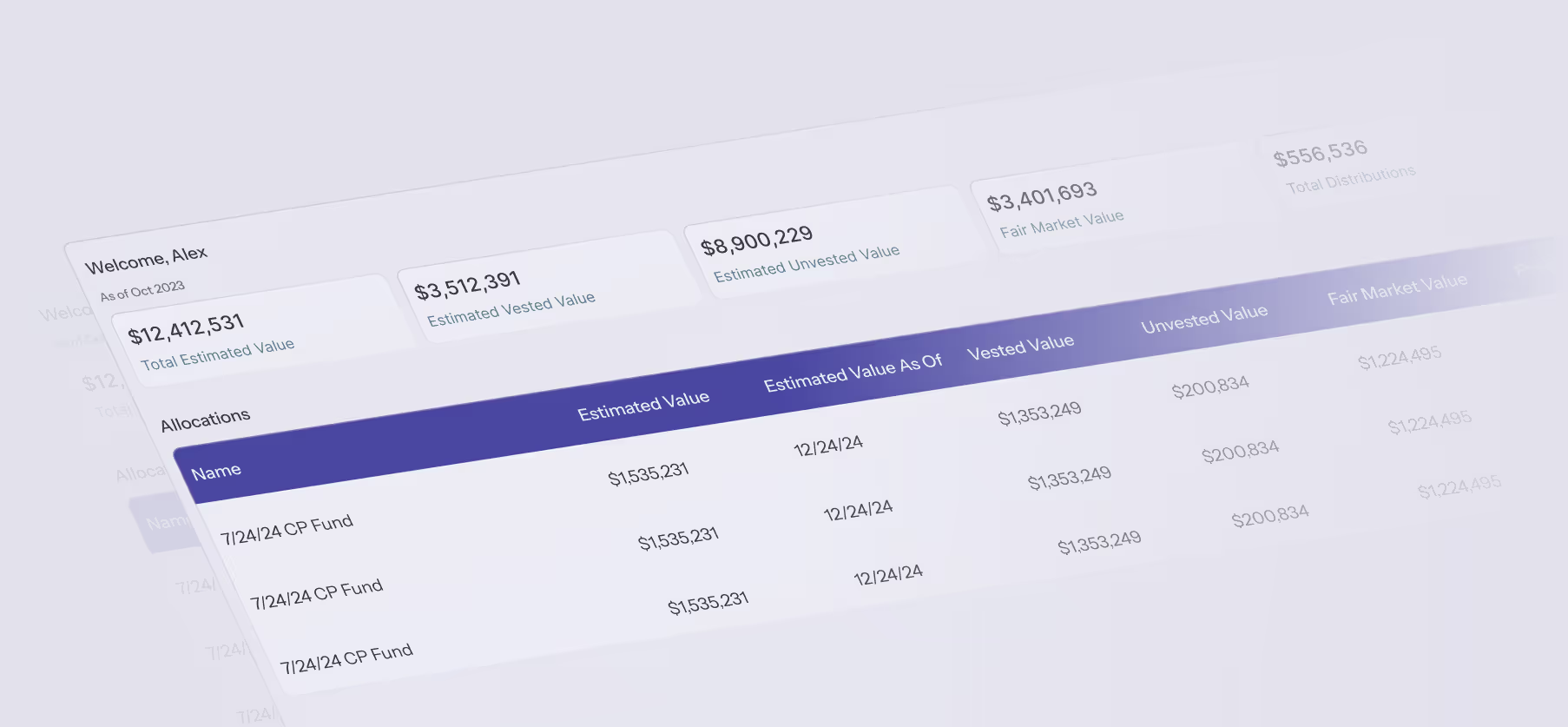
Navable enables carry simulations from the firm's live, governed allocation data — allowing leadership to test hiring scenarios, departures, performance sensitivity, and plan design without duplicating models or risking production records. Simulations always start from the current verified state, so results are grounded in accurate data. Book a demo →
Related Questions
- How do you model carried interest scenarios?
- How do you forecast carried interest distributions?
- How do you allocate carry to new partners?
- Managing carry dilution across funds
Common Questions
What's the difference between a carry simulation and a carry forecast?
A forecast projects expected outcomes under performance assumptions — "what is carry likely to be worth?" A simulation tests hypothetical changes to the carry structure itself — "what happens if we change who gets what, or how the plan works?" Both use the same baseline data but answer different questions.
How quickly should a firm be able to run carry simulations?
Fast enough to support real-time decision-making. If a managing partner asks "what if we grant this hire 4% across Funds III and IV?" during a compensation discussion, the answer should take minutes, not days. Spreadsheet-based simulations can't consistently deliver that speed.
Can you compare multiple simulation scenarios side by side?
In a purpose-built system, yes — multiple scenarios can be run and compared against each other and against the current baseline. In spreadsheets, each scenario is typically a separate file, making side-by-side comparison a manual exercise.