Direct Answer
You manage carry across SPVs by tracking each vehicle's carry terms, participant roster, and allocation data independently — while maintaining a consolidated view that rolls SPV-level carry into each participant's total position across the firm. Because SPVs often have unique terms defined in side letters or standalone operating agreements, the tracking system must handle vehicle-specific logic without losing the ability to report across all vehicles in aggregate.
Why SPV Carry Is a Distinct Tracking Challenge
SPVs (special purpose vehicles) are used for deal-specific investments, co-invest opportunities, or situations where a subset of the fund's capital is deployed outside the flagship structure. They're especially prevalent in venture capital, where firms may run dozens of SPVs alongside their main fund, but they're increasingly common in PE and real estate as well.
Each SPV is its own entity with its own economics. The carry terms may differ from the flagship fund — different percentages, different hurdle rates, different participant rosters. A partner who holds 15% carry in the flagship fund might hold 25% in an SPV they championed, and zero in another SPV led by a colleague. The GP commitment structure may differ. Distribution mechanics may be simpler or more complex than the main fund.
The tracking challenge is that SPVs are often set up quickly — sometimes in a matter of days to close on a deal opportunity — and their carry terms are documented in side letters or operating agreements rather than in the firm's standard carry plan. That informality means SPV carry often lives outside whatever tracking infrastructure the firm has for its flagship funds — in a separate spreadsheet, a PDF of the operating agreement, or occasionally just in someone's memory.
This works until someone asks a cross-vehicle question. What's Partner X's total carry exposure including SPVs? How do SPV distributions reconcile with the flagship fund? What's the firm's aggregate carry obligation across all vehicles? Answering these questions requires manually aggregating data from every SPV file — a process that doesn't scale and introduces errors with every additional vehicle.
What SPV Carry Tracking Requires
A system that handles SPV carry effectively needs to support a high volume of vehicles (firms may manage 20+ active SPVs), vehicle-specific carry terms that differ from the flagship fund, participant rosters that vary by SPV, the ability to roll up SPV-level data into participant-level and firm-level views, and a process for onboarding new SPVs quickly as deals arise. The system also needs to handle the reality that SPVs have shorter lifecycles than flagship funds — some may fully distribute within two to three years — which means carry events (crystallization, distribution, wind-down) happen more frequently and need to be tracked at the vehicle level.
How Navable Helps
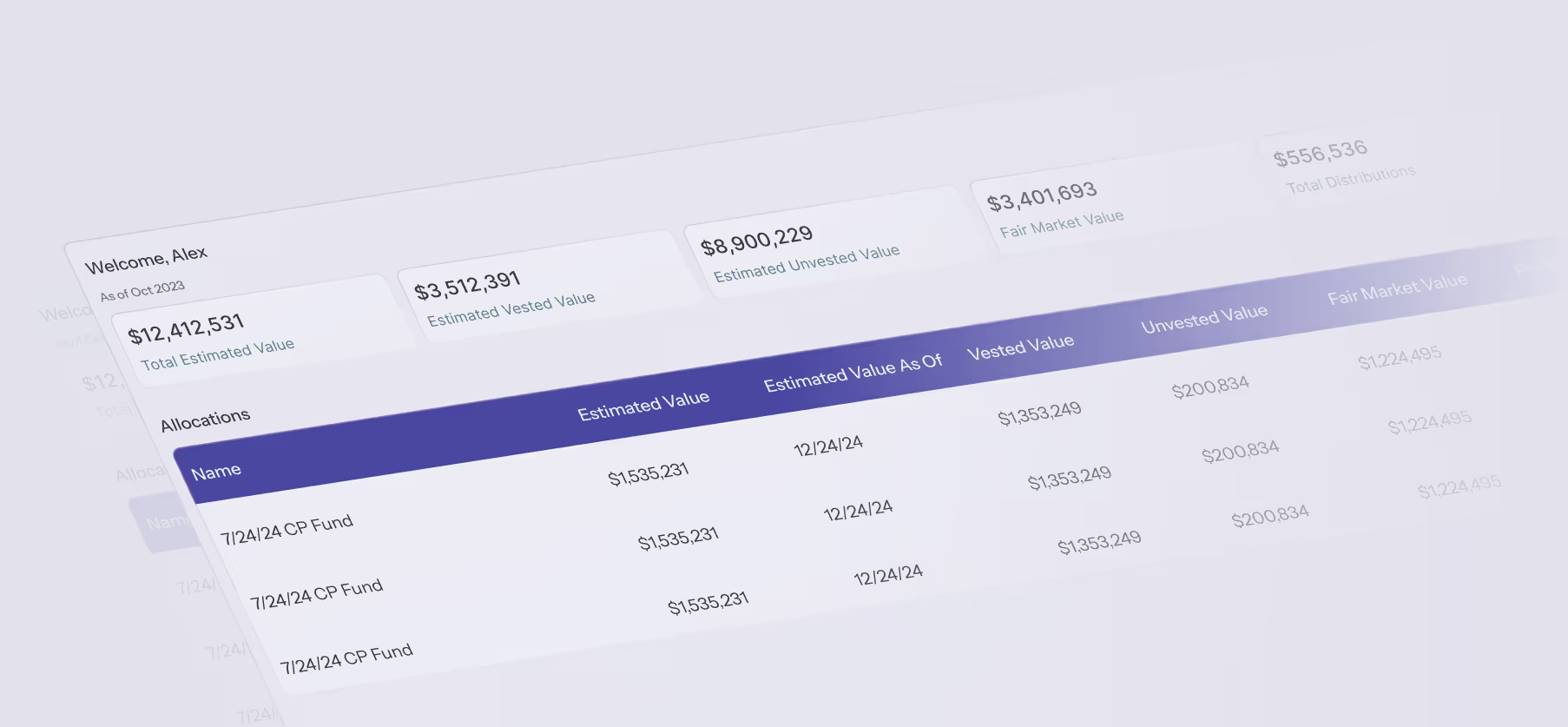
Navable supports carry tracking across flagship funds, SPVs, co-invest vehicles, and continuation funds in a single platform. Each vehicle maintains its own terms and participant roster, while the system provides consolidated views at the participant, fund, and firm level. New vehicles can be onboarded quickly without building a separate tracking infrastructure from scratch. Book a demo →
Related Questions
- How do VC firms track carried interest?
- How do you manage carry across multiple funds?
- Managing carry splits across deals and funds
- How do you centralize carry data across funds?
Common Questions
Do SPVs need their own carry tracking or can they share the flagship fund's model?
They need independent tracking. SPVs typically have different carry terms, different participants, and different distribution mechanics than the flagship fund. Forcing them into the flagship model creates inaccuracies; tracking them in standalone spreadsheets creates fragmentation. A centralized system handles both by supporting vehicle-specific terms within one platform.
How many SPVs can a firm realistically track in spreadsheets?
Most firms find spreadsheet-based SPV tracking becomes unmanageable beyond five to ten active vehicles — especially when cross-vehicle reporting and participant-level consolidation are required. Beyond that threshold, the reconciliation effort exceeds the value of maintaining separate files.
What happens to SPV carry when the vehicle winds down?
Final distributions are calculated based on the SPV's terms, carry crystallizes, and the vehicle is closed. The historical record — allocations, distributions, participant data — should be preserved in the system for audit and tax purposes, even after the SPV is no longer active.