Direct Answer
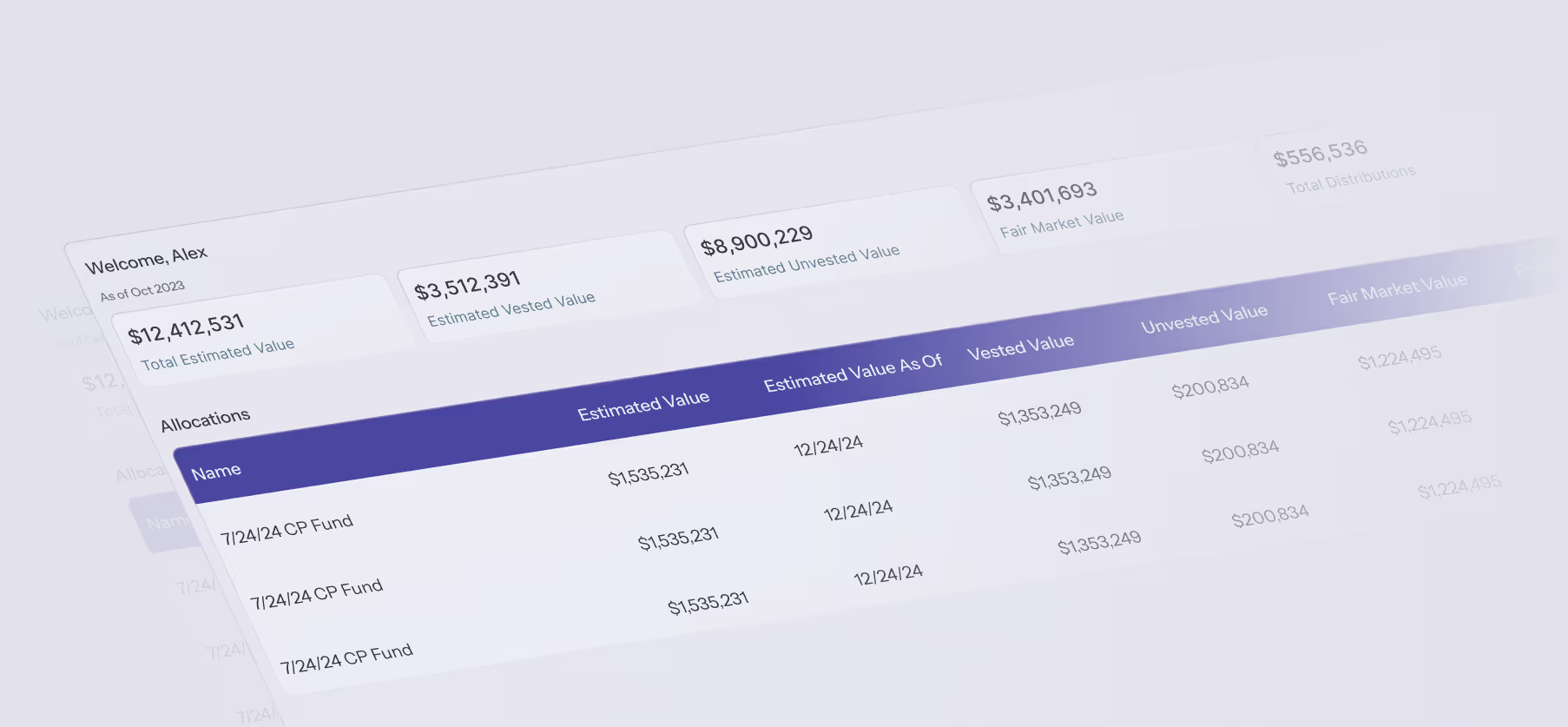
You manage carried interest across multiple funds by maintaining a centralized system of record that tracks each participant's allocations, vesting schedules, and ownership changes independently per fund — while giving finance teams a consolidated view across the entire firm. This requires time-aware tracking that accounts for different fund terms, overlapping vintages, and participants who hold carry in more than one vehicle.
Why Multi-Fund Carry Gets Complicated Fast
Managing carry in a single fund is a contained problem. One set of terms, one participant roster, one vesting timeline. The challenge scales non-linearly once a firm is running Fund I, II, and III simultaneously — each with its own carry pool, hurdle structure, vesting start dates, and participant list.
The complication isn't just that there are more funds. It's that participants overlap across them in different configurations. A founding partner may hold carry in all three funds at different percentages. A principal who joined before Fund II close may participate in Funds II and III but not Fund I. A departing VP may have vested carry in Fund I, partially vested in Fund II, and no participation in Fund III. Each of these situations needs to be tracked independently per fund but reportable in aggregate — for the individual, for leadership, and for auditors.
What makes this operationally difficult is that changes in one fund often have implications across others. A promotion affects allocation percentages in the current fund and may trigger grants in the next. A departure triggers forfeiture rules that differ by fund vintage. A mid-cycle rebalancing in Fund III doesn't change Fund II, but a partner reviewing their total compensation needs to see both in one view.
Where Spreadsheets Break Down
Most firms start with a separate spreadsheet per fund, which works until someone asks a cross-fund question: "What's Partner X's total carry exposure across all vehicles?" or "If we promote this principal, how does it affect the pool in Fund II and Fund III?"
Answering those questions requires manually pulling data from multiple files, reconciling definitions that may not be consistent across models, and hoping nothing was updated in one file but not the others. Version control degrades quickly, and the reconciliation effort before each distribution event or comp review grows with every fund added.
The problem compounds further when firms add co-invest vehicles, continuation funds, or SPVs — each with their own carry or promote structures that sit alongside the flagship funds.
What Good Multi-Fund Carry Management Looks Like
Firms that handle this well centralize all carry data — across every fund, deal, and participant — into one governed environment. Each fund maintains its own terms and allocation logic, but the system provides a unified view of any participant's total carry position across vehicles. Changes are tracked with timestamps and approval workflows, so there's never ambiguity about what changed, when, or why. And reporting works at both levels: fund-by-fund detail for distributions and audits, and firm-wide rollups for compensation planning and partner reviews.
How Navable Helps
Navable is built for multi-fund carry management. It tracks allocations, vesting, and ownership changes across every fund and vehicle in a single platform — giving finance teams both the fund-level precision they need for distributions and the firm-wide visibility they need for compensation and partner reporting. Book a demo →
Common Questions
Do each fund's carry terms need to be tracked separately?
Yes. Each fund typically has its own LPA-defined carry structure, hurdle rates, vesting schedules, and participation rules. A multi-fund tracking system must respect those differences while still rolling up data into a consolidated view.
How do continuation funds and co-invest vehicles affect multi-fund carry?
They add additional carry or promote structures that run alongside flagship funds, often with different terms and different participant subsets. Without centralized tracking, these vehicles become reconciliation headaches — especially during distributions or year-end reporting.
Can you report an individual's total carry across all funds?
With a centralized system, yes — in real time. With spreadsheets, it requires manual aggregation from multiple files, which introduces lag, inconsistency, and the risk of errors in what's often the most sensitive data a firm reports to its partners.
Related Questions
- How do you track carried interest allocations?
- What is carried interest tracking software?
- How do you centralize carry data across funds?
- How do you handle carry when a partner leaves mid-fund?