Direct Answer
You centralize carry data by migrating allocation records, vesting schedules, participant information, and ownership history from fund-level spreadsheets into a single, governed system of record. The process typically starts with one fund as a pilot, standardizes definitions and tracking rules across vehicles, and expands incrementally — giving the firm a unified view of carry across all funds, deals, and participants without requiring a disruptive big-bang transition.
Why Centralization Becomes Necessary
Most firms don't intentionally build fragmented carry data. It happens organically. Fund I gets its own spreadsheet. Fund II gets a copy with modifications. A co-invest vehicle gets tracked in a separate file. An SPV's carry terms live in a side letter that nobody mapped into the main model. Before long, the firm's carry "system" is a collection of disconnected files maintained by different people on different schedules.
This works until it doesn't — and the breaking point is usually a cross-fund question that nobody can answer quickly. What's Partner X's total carry across all vehicles? How did the leaver's forfeiture affect both Fund II and Fund III? Can we produce an audit-ready trail of every allocation change across the firm? When answering these questions requires days of manual aggregation and reconciliation, the cost of fragmentation becomes impossible to justify.
How to Approach Centralization
The mistake most firms make is treating centralization as a technology migration. It's really a data governance exercise. The technology matters, but the harder work is standardizing the data itself.
Start by inventorying what exists. Map every spreadsheet, model, and document that contains carry-related data — allocations, vesting schedules, participant lists, historical distributions, side letters with special terms. Most firms are surprised by how much carry logic is scattered across how many locations.
Standardize definitions before migrating data. "Vested" may mean different things in different fund models. "Allocated" may include reserves in one file and exclude them in another. Centralizing inconsistent data just moves the problem — it doesn't solve it. Lock down definitions first: what does vested mean, what's the difference between accrued and distributed, who qualifies as an eligible participant in each fund?
Pilot with one fund. Pick something complex enough to prove value — multiple participants, active vesting, historical changes — but manageable enough to migrate quickly. A successful pilot builds internal confidence, reveals edge cases in the data, and establishes the governance patterns that will apply to subsequent funds.
Establish governance for ongoing maintenance. Centralization is only valuable if the centralized data stays accurate. That means defining who can make allocation changes, what the approval workflow is, how exceptions are documented, and how often the data is formally reviewed. Without governance, centralization just creates a single point of failure instead of multiple ones.
Expand fund by fund. Once the pilot is validated, add the remaining funds incrementally. Each migration gets faster as governance patterns are already established and the team is familiar with the process.
What the End State Looks Like
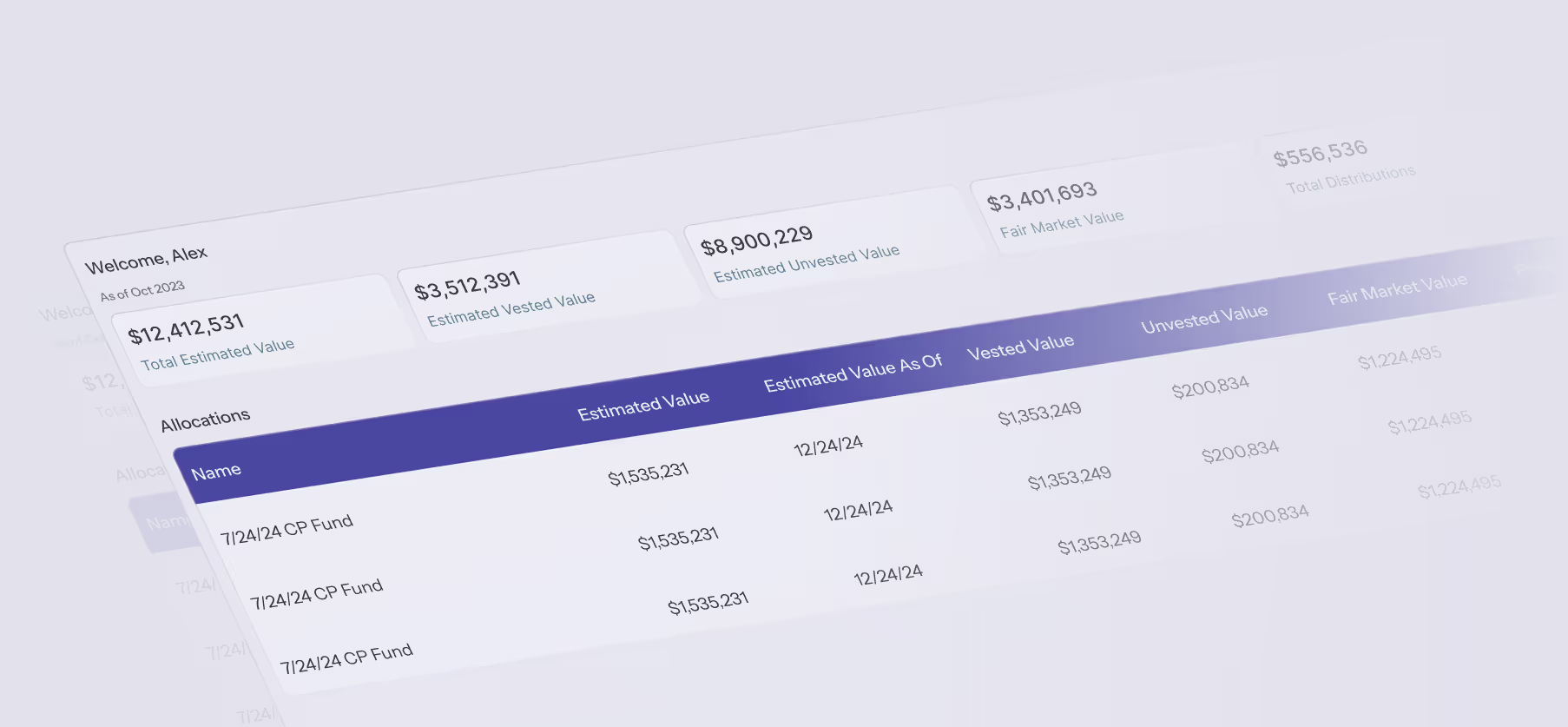
After centralization, the firm has a single system that holds every fund's allocation data, vesting rules, and participant records in one place. Cross-fund reporting is instant. Audit trails are complete. Distribution calculations pull from the same data that partner statements reference. And questions that used to take days to answer — across multiple files, with manual reconciliation — take seconds.
How Navable Helps
Navable is built to centralize carry data across funds, vehicles, and participants. The platform provides white-glove onboarding support that typically gets firms set up in under three weeks — migrating allocation data, vesting rules, and participant records into a single audit-ready system. Once live, all carry data is governed in one place with full change history, automated reporting, and real-time visibility for finance teams and partners. Book a demo →
Related Questions
- What are carry allocation tracking best practices?
- How do you manage carry across multiple funds?
- What are the problems with managing carry in Excel?
- What is carried interest tracking software?
Common Questions
How long does it take to centralize carry data?
It depends on the number of funds and the cleanliness of existing records. A single-fund pilot can typically be completed in two to three weeks. Full firm-wide centralization across multiple vintages and vehicles may take one to three months, depending on complexity.
Do you need to centralize historical data, or just go forward?
Both. Historical data is critical for audits, partner statements, and validating that current allocations are accurate. Migrating historical records takes more effort upfront, but without it, the centralized system can't answer "what did this look like at the time of that event?" — which is often the most important question.
What's the biggest risk of centralizing carry data?
Centralizing bad data. If definitions aren't standardized and historical records aren't cleaned before migration, the new system inherits the same inconsistencies that made spreadsheets unreliable. That's why the definition and inventory steps come first.