Direct Answer
Best practice fund admin carry tracking means maintaining a standardized, governed process across all GP clients — using a centralized platform that captures allocations, vesting, ownership changes, and reporting in one system per client while providing the fund admin with a scalable operating framework. The goal is consistent service delivery, audit-ready documentation, and the ability to add new clients without proportionally increasing manual workload.
The Best Practices That Separate Scalable Admins from Struggling Ones
Fund administrators managing carry on behalf of multiple GP clients face a unique challenge: every client's carry structure is different, but the quality, accuracy, and auditability of the service needs to be identical. The admins that handle this best follow a common set of operational principles.
Standardize the workflow, customize the terms. The process for how changes are initiated, approved, applied, and documented should be the same across every client. What varies — carry pool structure, vesting rules, forfeiture provisions, reporting format — should be configurable within that standard framework. This prevents the operational drift that occurs when each client's carry is managed through a bespoke spreadsheet built by a different analyst.
Capture GP instructions formally. Allocation changes from GPs arrive through emails, calls, or marked-up documents. Best practice is to formalize these instructions into structured change requests before applying them — creating a documented link between the GP's direction and the action taken. This protects both the fund admin and the GP during audits.
Maintain complete audit trails automatically. Every change to a client's carry data — who made it, when, what the prior state was — should be captured by the system, not documented manually after the fact. Manual audit trail maintenance is unreliable and doesn't scale across a growing client base.
Generate reports from the source data. Participant statements, management summaries, and LP-facing reports should be produced directly from the same governed dataset — not assembled from separate models or manually formatted exports. This eliminates the reconciliation step that turns every reporting cycle into a bottleneck.
Build for client onboarding speed. The faster a fund admin can onboard a new GP client's carry data — allocation records, vesting rules, participant information, historical changes — the faster they can begin delivering value. A standardized platform with templated onboarding processes enables this; client-specific spreadsheet builds do not.
How Navable Helps Fund Administrators
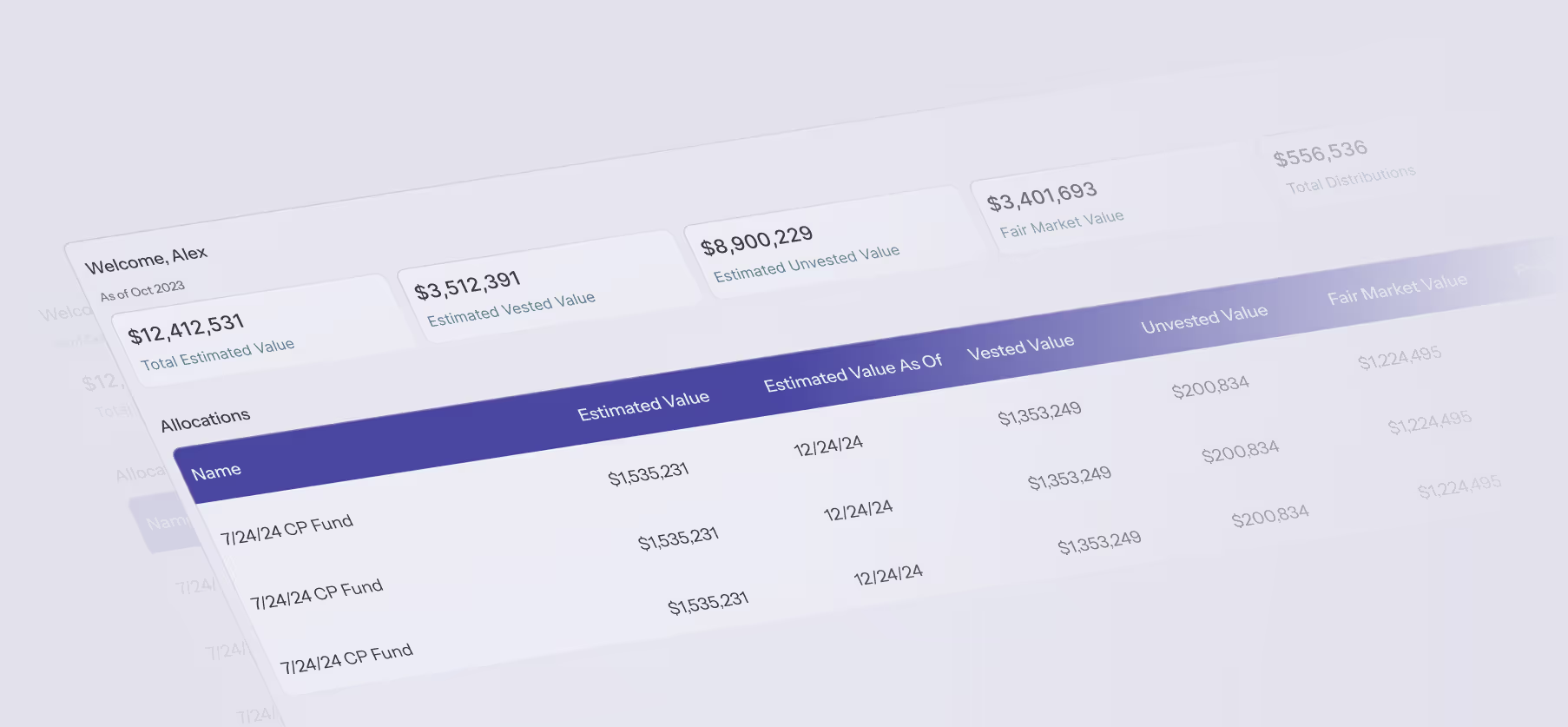
Navable provides fund administrators with a scalable carry management platform that standardizes workflows across all GP clients while supporting client-specific carry terms, vesting rules, and reporting requirements. Built-in audit trails, automated reporting, and white-glove onboarding support enable fund admins to deliver consistent, enterprise-grade carry services — and to grow their client base without proportionally growing their team. Book a demo →
Related Questions
- How do fund administrators track carried interest?
- The carry reconciliation process for fund admins
- What are carry allocation tracking best practices?
- Tools for fund admin carry management
Common Questions
How many GP clients can a fund admin realistically support on spreadsheets?
It varies by complexity, but most admins find that beyond five to ten clients, spreadsheet-based carry management consumes disproportionate analyst time on reconciliation and quality assurance. A centralized platform extends that capacity significantly.
Should fund admins offer carry tracking as a standalone service?
Increasingly, yes. Carry tracking is a high-value service that differentiates fund admins from competitors. A scalable platform enables admins to offer it as a defined service line rather than an informal add-on buried in the general fund accounting engagement.
How do fund admins handle clients with legacy carry data in spreadsheets?
Through a structured migration process: inventory the existing data, standardize definitions, pilot with one fund, then expand. The fund admin's onboarding process should include a data validation step to ensure historical records are accurate before they enter the centralized system.