Direct Answer
You ensure accuracy in carry calculations by maintaining clean, current allocation data in a single governed system — then generating calculations directly from that data without manual bridging, re-entry, or reconciliation between disconnected models. Accuracy is a function of data quality and process governance, not calculation complexity.
Why Accuracy Is a Data Problem
The calculation side of carry is technically straightforward — apply allocation percentages to distributable amounts, adjusted for vesting status and plan terms. The reason carry calculations go wrong isn't that the formulas are complex. It's that the data feeding those formulas is unreliable.
Allocation percentages that don't reflect a recent change. Vesting status that wasn't updated after a milestone passed. A participant who left but hasn't been removed from the model. A deal-level split applied where a fund-level split was intended. Each of these data issues produces a mathematically correct but factually wrong result — and the error flows directly into distribution amounts, partner statements, and tax reporting.
The most effective way to ensure accuracy isn't to add more validation steps after the calculation is complete. It's to ensure the data going in is correct, current, and consistent in the first place.
The Three Layers of Carry Accuracy
Source data accuracy. This is the foundation: every participant's allocation, vesting status, entity mapping, and plan terms must be correct and current. When this data lives in a governed system with controlled change processes, it's reliable by design. When it lives in spreadsheets maintained by different people on different schedules, accuracy depends entirely on manual discipline.
Calculation integrity. The logic that applies allocation data to distributable amounts must be correct and consistent. In a dedicated system, this logic is encoded once and applied uniformly. In spreadsheets, it's rebuilt or copied each cycle — introducing opportunities for formula errors, reference breaks, and version drift.
Output consistency. The results of the calculation — distribution amounts, participant shares, statements — must be consistent across all downstream outputs. When distributions, statements, and management reports all pull from the same calculation, consistency is structural. When they're produced from parallel models, reconciliation is the only safeguard — and it's imperfect.
The False Confidence of Manual Review
Many firms rely on multi-step manual review cycles to ensure carry accuracy — the calculation is run, reviewed by a second analyst, compared against the prior period, and signed off by the controller. This process catches some errors, but it's fundamentally limited by the quality of the data it's reviewing. If the source data contains a silent error — one that looks plausible but reflects an outdated state — the review process is likely to approve it.
Systematic accuracy requires structural controls at the data layer, not just vigilance at the output layer.
How Navable Helps
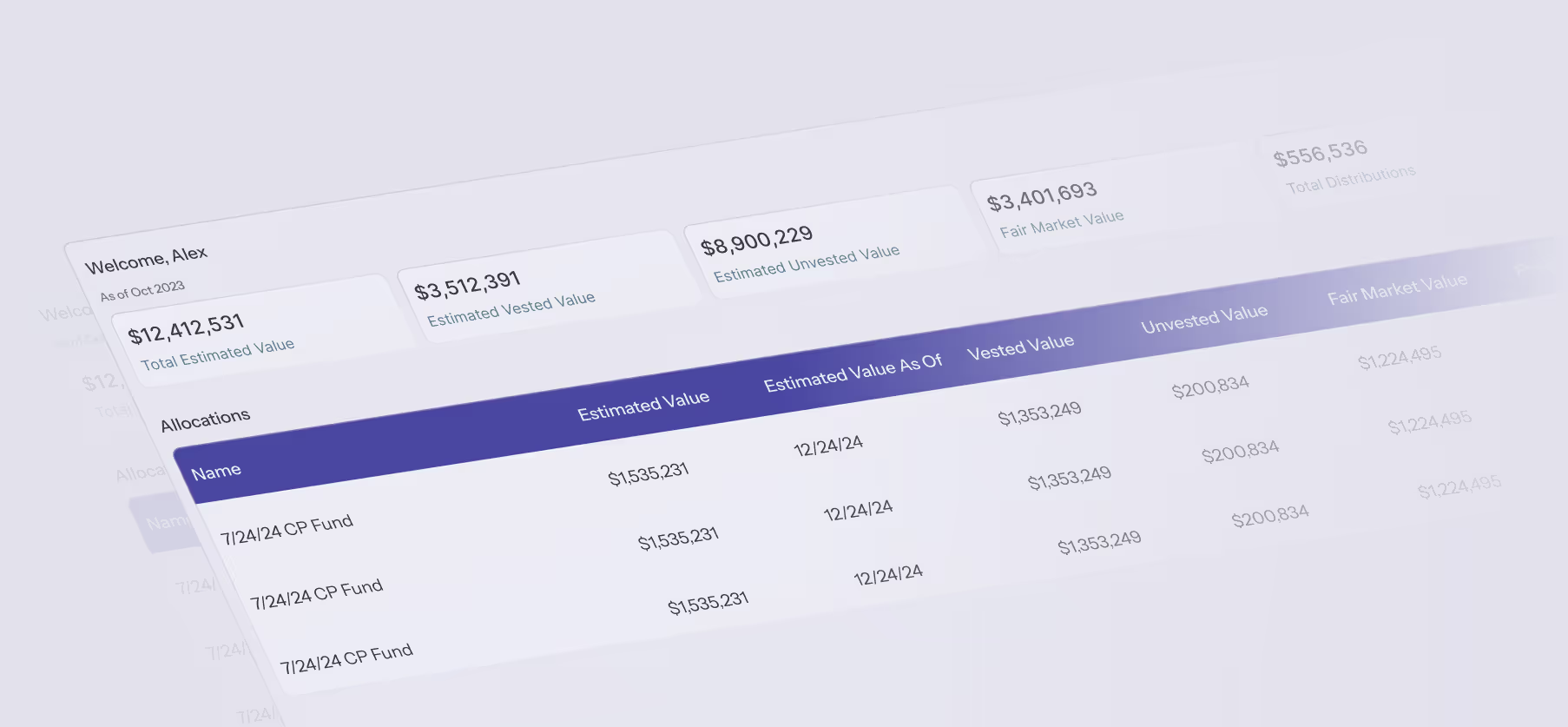
Navable ensures carry calculation accuracy from the source — maintaining allocation data, vesting records, and participant information in a single governed system. Calculations are generated directly from this data, eliminating the manual bridging and re-entry where most errors originate. The result is carry outputs that are accurate by design, not by the thoroughness of the review cycle. Book a demo →
Related Questions
- Common errors in carry calculations
- How do you validate carry allocations?
- Reducing risk in carry tracking
- Internal controls for carry management
Common Questions
What's more important for carry accuracy — better formulas or better data?
Better data. The formulas are rarely the issue. Accuracy failures almost always trace back to allocation data that was stale, inconsistent, or manually transferred between systems.
How do you know if your carry calculations are accurate?
Validate that individual allocations sum to the total pool, that each participant's percentage traces to their documented grant history, and that the data used for the calculation reflects the correct point in time. If all three checks pass, the calculation is structurally sound.
Does automation guarantee accuracy?
Automation eliminates manual execution errors, but accuracy still depends on the correctness of the rules and data the system applies. Automation ensures consistent execution; data governance ensures correct inputs.