Direct Answer
The most common errors in carry calculations stem from stale or inconsistent allocation data — not from flawed math. They include applying outdated ownership percentages to distributions, misaligning fund-level and deal-level splits, failing to account for mid-period changes (departures, vesting events, reallocations), double-counting or omitting participants across entities, and using the wrong version of a spreadsheet model for production calculations.
Why Carry Errors Are Data Problems, Not Math Problems
The formulas behind carry calculations — allocation percentages applied to distributable amounts — are straightforward. What makes carry error-prone is the data those formulas depend on. If the underlying allocation records are stale, inconsistent across files, or reflect a different point in time than the distribution event, the output will be wrong regardless of how correct the formula is.
This distinction matters because firms often respond to carry errors by adding more validation steps to their calculation process — more cross-checks, more review cycles, more manual reconciliation. But if the root cause is unreliable source data, additional downstream validation doesn't fix the problem. It just catches some of the symptoms.
The Errors That Surface Most Often
Distributing based on outdated allocations. A partner left two months ago, their forfeiture was processed in the internal tracker, but the distribution model still shows them as active. Or a mid-year reallocation was applied to the Fund III model but not to the co-invest vehicle. The result: real dollars distributed to the wrong people, or in the wrong amounts.
Misapplying fund-level vs. deal-level splits. In firms that use both structures, applying the fund-level percentage to a deal-level distribution (or vice versa) is a common and consequential error. It requires knowing which split applies to which event — information that's easy to lose when allocations are spread across multiple spreadsheets.
Missing mid-period changes. A vesting milestone occurs mid-quarter. A new participant is granted carry effective March 1 but isn't added to the model until the next full update in June. A leaver's forfeiture is calculated correctly but the reallocated points aren't distributed to remaining participants until the next cycle. Each of these timing gaps can produce incorrect calculations for the period they span.
Entity mapping errors. A participant holds carry through a personal trust, but the distribution model maps the payment to their individual name. Or two entities controlled by the same person are treated as separate participants. These errors affect distribution routing, tax reporting, and participant statements simultaneously.
Version confusion. The scenario model that was built to test a "what-if" allocation change gets inadvertently used as the production model. Or a file saved locally diverges from the shared version after both are edited independently. In spreadsheet environments, there's no structural safeguard against this.
The Common Thread
Every one of these errors traces back to the same root cause: carry allocation data and carry calculation logic living in disconnected, ungoverned environments. When the data is fragmented, manual bridging introduces errors. When the environment is ungoverned, those errors persist undetected until they surface in a distribution, a statement, or an audit.
How Navable Helps
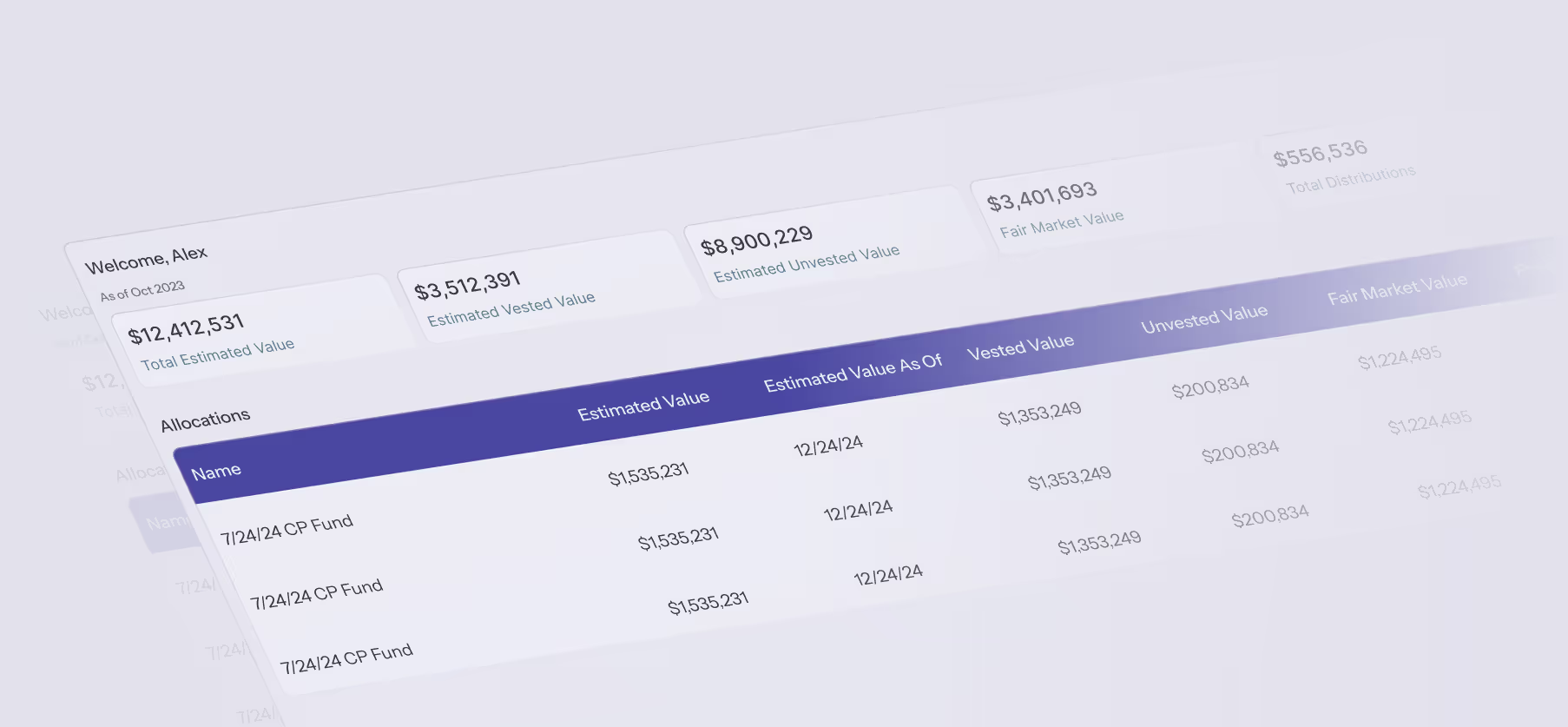
Navable eliminates the most common carry calculation errors by maintaining allocation data, vesting records, and participant information in a single governed system. Because distribution calculations pull from the same source that tracks ownership changes, there's no gap between what the allocation records say and what the calculation engine uses. Book a demo →
Related Questions
- How do you validate carry allocations?
- Ensuring accuracy in carry calculations
- What are the problems with managing carry in Excel?
- Reducing risk in carry tracking
Common Questions
What's the most expensive carry calculation error?
Distributing real dollars based on incorrect ownership percentages. Unlike reporting errors (which can be corrected on paper), distribution errors require clawbacks, amended tax documents, and uncomfortable conversations with partners — each of which carries financial and reputational cost.
How do firms catch carry calculation errors before distributions?
Through pre-distribution review cycles that compare allocation data against the distribution model. This process is more reliable when both draw from the same system of record — and less reliable when it requires manual reconciliation between disconnected spreadsheets.
Are carry calculation errors always the firm's fault?
Not always. Fund admin errors, incorrect GP instructions, or misinterpreted plan terms can also cause issues. But the firm is ultimately responsible for validating the outputs before money moves — and the quality of that validation depends on the quality of the underlying data.