Direct Answer
Finance teams get better carry visibility by centralizing all allocation data, vesting records, and participant information into a single system that provides real-time dashboards, on-demand reporting, and queryable data across funds, participants, and entities. Visibility means the finance team can answer any carry-related question — from partner-level detail to firm-wide rollups — without manual data assembly, and can proactively surface issues rather than discovering them during distributions or audits.
The Visibility Gap in Most Firms
At many firms, the finance team technically "has" carry data — it exists in spreadsheets on shared drives, in fund admin reports, and in internal models. But having data and having visibility are different things.
Visibility means being able to answer questions in real time without assembling information from multiple sources. It means seeing the current state of allocations across every fund and participant, not the state as of the last time someone updated the model. It means understanding how a recent change — a departure, a new grant, a vesting milestone — has rippled through the firm's carry obligations, without running a manual reconciliation first.
Most finance teams lack this. They can produce carry information when asked, but the production process takes hours or days, involves pulling from multiple files, and the result reflects a point in time that may already be stale by the time it's delivered. The finance team operates reactively — fielding ad-hoc requests from partners, leadership, and auditors — rather than proactively managing carry as a strategic dataset.
What Finance Teams Actually Need to See
Firm-wide carry position. Total carry obligations across all active funds, how the pools are allocated, what's reserved, and how current exposures compare to historical norms. This is the board-level and CFO-level view.
Fund-level detail. Each fund's carry pool, participant roster, allocation percentages, vesting status, and any recent changes. This is the operational view used for distribution preparation and fund-level reporting.
Participant-level records. Each individual's allocations across all funds, vesting progression, estimated carry value, and change history. This is what drives partner statements, compensation reviews, and HR planning.
Change activity. A running view of recent allocation changes — new grants, forfeitures, vesting events, reallocations — with the ability to see what changed, when, and who approved it. This is the governance view that keeps the finance team in control.
Projected outcomes. Forecasted carry values at the participant and fund level under current performance assumptions. This turns carry from a retrospective record into a forward-looking planning tool.
Why Visibility Is a System Problem, Not a Reporting Problem
Firms often try to solve the visibility gap by producing better reports — more detailed spreadsheets, better-formatted partner statements, more frequent updates. But the underlying issue isn't the output format. It's the data architecture. When carry data is fragmented across multiple files, maintained by different people, and reconciled only periodically, no amount of reporting polish produces genuine real-time visibility.
Visibility is a structural outcome of centralized, governed data. When every carry record lives in one system, visibility is inherent — the system can answer any query, at any level of detail, at any time, without manual assembly.
How Navable Helps
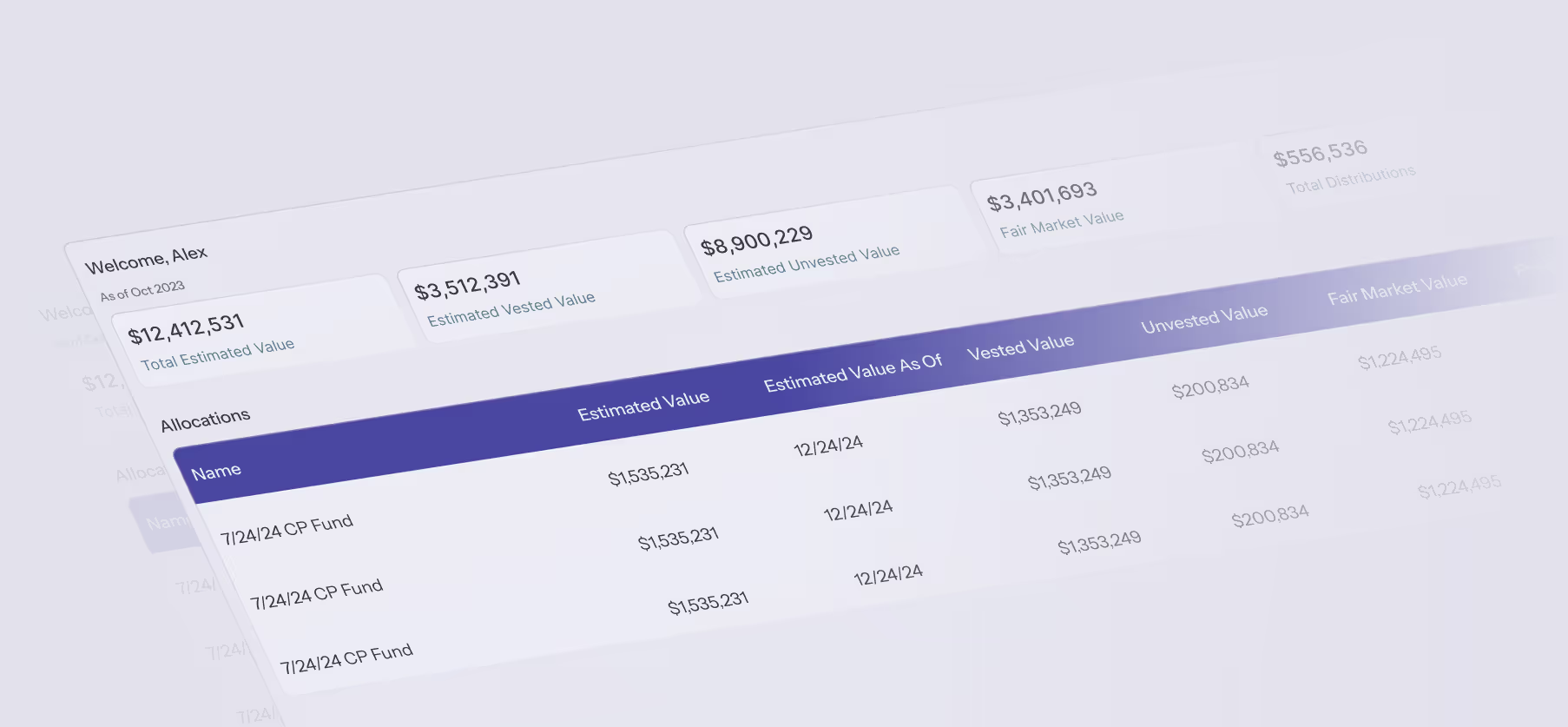
Navable gives finance teams real-time visibility into carry across every fund, participant, and entity — through dashboards, on-demand reports, and a centralized data model that eliminates manual assembly. CFOs see the firm-wide position. Controllers see fund-level detail. Partners and employees see their individual carry through a dedicated portal. Everyone draws from the same governed source. Book a demo →
Related Questions
- The carry reporting process in private equity
- How do you track carry ownership by partner?
- How do you forecast carried interest distributions?
- What are carry allocation tracking best practices?
Common Questions
What's the difference between carry reporting and carry visibility?
Reporting produces documents at scheduled intervals. Visibility means being able to access and query carry data at any time, at any level of detail, without waiting for a report to be built. Visibility is continuous; reporting is periodic.
Should partners and employees have self-serve carry visibility?
Yes. Self-serve portal access dramatically reduces the volume of ad-hoc requests that land on the finance team — and it reinforces the retention value of carry by making it tangible rather than opaque.
How quickly should a finance team be able to answer a carry question?
Seconds to minutes for any standard query — participant-level detail, fund-level rollup, or firm-wide summary. If the answer requires hours of data assembly, the issue isn't the question. It's the data architecture.