Direct Answer
Venture capital firms track carried interest by maintaining a system that records carry allocations across flagship funds, SPVs, and deal-specific vehicles — accounting for the evolving participation, non-standard structures, and long time horizons that define VC fund economics. Because VC firms often manage dozens of vehicles simultaneously with overlapping teams and staggered vintages, the tracking challenge is structurally different from PE and requires flexibility that spreadsheets can't sustain at scale.
What Makes VC Carry Tracking Different
Venture capital carry tracking shares the fundamentals with PE — allocations, vesting, forfeitures, distributions — but the structural complexity is distinct in several ways.
More vehicles, smaller teams. A single VC firm may run three flagship funds alongside ten or more SPVs, opportunity funds, or scout vehicles. Each has its own carry structure, but the team managing them overlaps heavily. A partner who holds 15% carry in the flagship fund may hold 25% in one SPV and nothing in another. Tracking that matrix across a growing vehicle count gets unwieldy fast.
Deal-by-deal participation is more common. Many VC firms structure carry so that participation varies by deal — particularly in SPVs where specific partners sourced or led the investment. This creates a tracking burden that scales with every new deal: different participants, different percentages, and potentially different vesting terms for each.
Long hold periods amplify tracking drift. VC investments are held for 7–12 years or more. Over that timeframe, teams change significantly. Partners leave, new GPs join, junior team members get promoted into carry participation. The carry model needs to reflect all of those changes accurately against original allocations that were set years earlier — and the longer the time horizon, the more opportunities for tracking gaps to accumulate.
Evolving participation across vintages. As VC firms grow, carry participation broadens from founding partners to a wider team. Fund I might have three carry holders; Fund IV might have fifteen. The tracking system needs to handle that expansion without creating inconsistencies in how earlier funds are managed.
Where VC Firms Get Into Trouble
The most common failure pattern in VC carry tracking is fragmentation — a separate spreadsheet or model for each vehicle, with no single view that ties them together. When a partner asks "what's my total carry across all vehicles?" or a tax advisor needs K-1 data across the firm, someone has to manually aggregate data from a dozen files.
The other frequent issue is SPV tracking. SPVs are often set up quickly, with carry terms documented in side letters or operating agreements rather than a standardized format. Without a system that can ingest those terms and track participation at the vehicle level, SPV carry becomes an afterthought — until distribution time, when it suddenly requires urgent reconciliation.
What VC-Specific Carry Tracking Requires
A carry tracking system built for venture capital needs to handle a high volume of vehicles with relatively small participant counts per vehicle, deal-level and vehicle-level participation that varies across the platform, staggered fund vintages with overlapping teams, SPV-specific terms that differ from flagship fund structures, and long time horizons where participant rosters change multiple times before a single exit occurs.
The system needs to scale horizontally (more vehicles) rather than just vertically (more complexity per fund) — which is a different design challenge than PE-centric platforms often solve for.
How Navable Helps
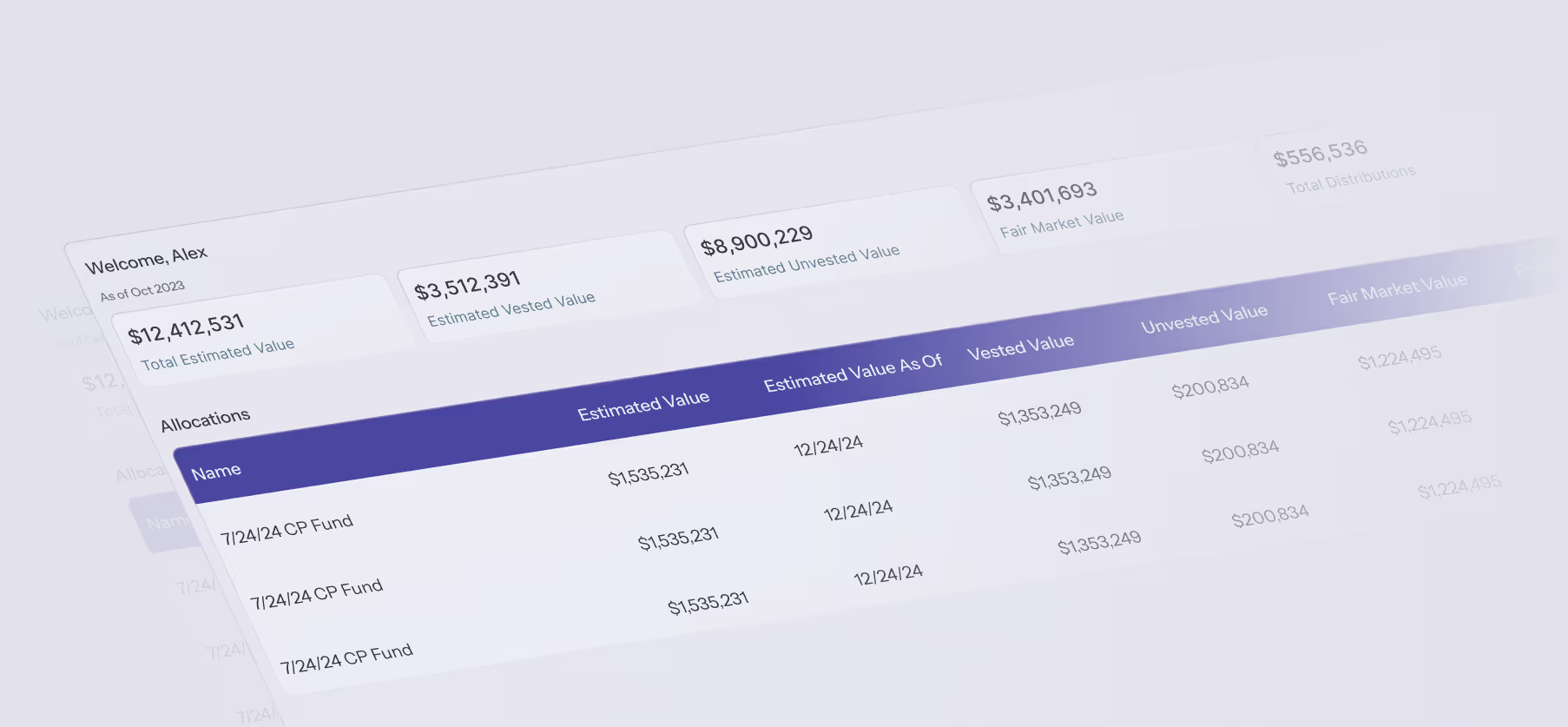
Navable is built for multi-fund VC platforms managing carry across flagship funds, SPVs, and deal-specific vehicles. It tracks allocations and vesting at the participant level across every vehicle, handles evolving participation as teams grow, and gives partners real-time visibility into their total carry position. Firms use Navable to eliminate the fragmentation that comes with managing dozens of vehicles in disconnected spreadsheets. Book a demo →
Related Questions
- How do you manage carry across multiple funds?
- How do you track carry ownership by partner?
- What is carried interest tracking software?
- How do SPVs impact carry allocation tracking?
Common Questions
Do SPVs need separate carry tracking from the flagship fund?
Yes. SPVs typically have their own carry terms, participant rosters, and distribution waterfalls. They must be tracked independently but viewable alongside flagship fund carry for consolidated partner reporting.
How does carry work differently in VC vs. PE?
The core mechanics are similar, but VC carry is more commonly structured at the fund or vehicle level (European waterfall), with participation varying more frequently across deals and vehicles. VC also involves longer hold periods and higher vehicle counts, which creates a broader but shallower tracking challenge.
How do VC firms handle carry for junior team members and scouts?
Many VC firms grant carry to a broader set of participants than PE firms, including associates, scouts, and venture partners. This expands the participant base significantly and requires scalable tracking infrastructure — particularly around vesting schedules that may span the full 10+ year fund life.