Direct Answer
You forecast carried interest distributions by projecting fund-level performance outcomes (exit multiples, timing, deployment pace) and applying each participant's allocation percentages, vesting status, and plan terms to estimate their individual carry payouts under various scenarios. Effective carry forecasting requires current allocation data, configurable performance assumptions, and the ability to model multiple scenarios — producing participant-level projections that leadership can use for compensation planning, retention decisions, and financial modeling.
Why Carry Forecasting Matters
Carried interest is the single largest component of long-term compensation for most GP participants — yet at many firms, it's also the least visible. Partners and employees know they hold carry, but they often can't answer basic questions: What's it likely to be worth? When might distributions occur? How does my position compare across funds?
For leadership, the blind spot is equally consequential. Without forecasting, the firm can't project its aggregate carry obligations, model how performance sensitivity affects payout timing, plan for the tax and cash flow implications of upcoming distributions, or use carry data strategically in hiring and retention conversations.
Carry forecasting turns static allocation data into forward-looking intelligence — giving both the firm and its participants a data-driven view of what carry is actually likely to produce.
What Carry Forecasting Requires
A credible carry forecast needs three inputs working together.
Current, accurate allocation data. The forecast is only as reliable as the baseline it starts from. If allocation records are stale, if vesting status hasn't been updated, or if recent changes haven't been applied, the forecast produces numbers that look precise but are built on an unreliable foundation.
Configurable performance assumptions. Forecasts should model multiple return scenarios — base case, upside, downside — at the fund level. These assumptions drive the total carry pool estimate, which is then allocated to individual participants based on their current ownership and vesting status.
Plan-aware distribution logic. The forecast needs to apply the fund's specific terms — hurdle rates, catch-up provisions, clawback exposure — to determine when and how carry is likely to flow to participants. A gross carry estimate without plan-level mechanics is directionally useful but not precise enough for compensation planning or financial modeling.
The Difference Between Forecasting and Scenario Modeling
Forecasting and scenario modeling are complementary but distinct. Forecasting projects likely outcomes under a set of performance assumptions — it answers "what is carry expected to be worth?" Scenario modeling tests hypothetical changes to the carry structure itself — it answers "what happens if we change allocations, add a participant, or modify terms?"
Both require the same governed baseline data, which is why they're most effective when run from the same platform rather than produced in disconnected spreadsheet models.
How Navable Helps
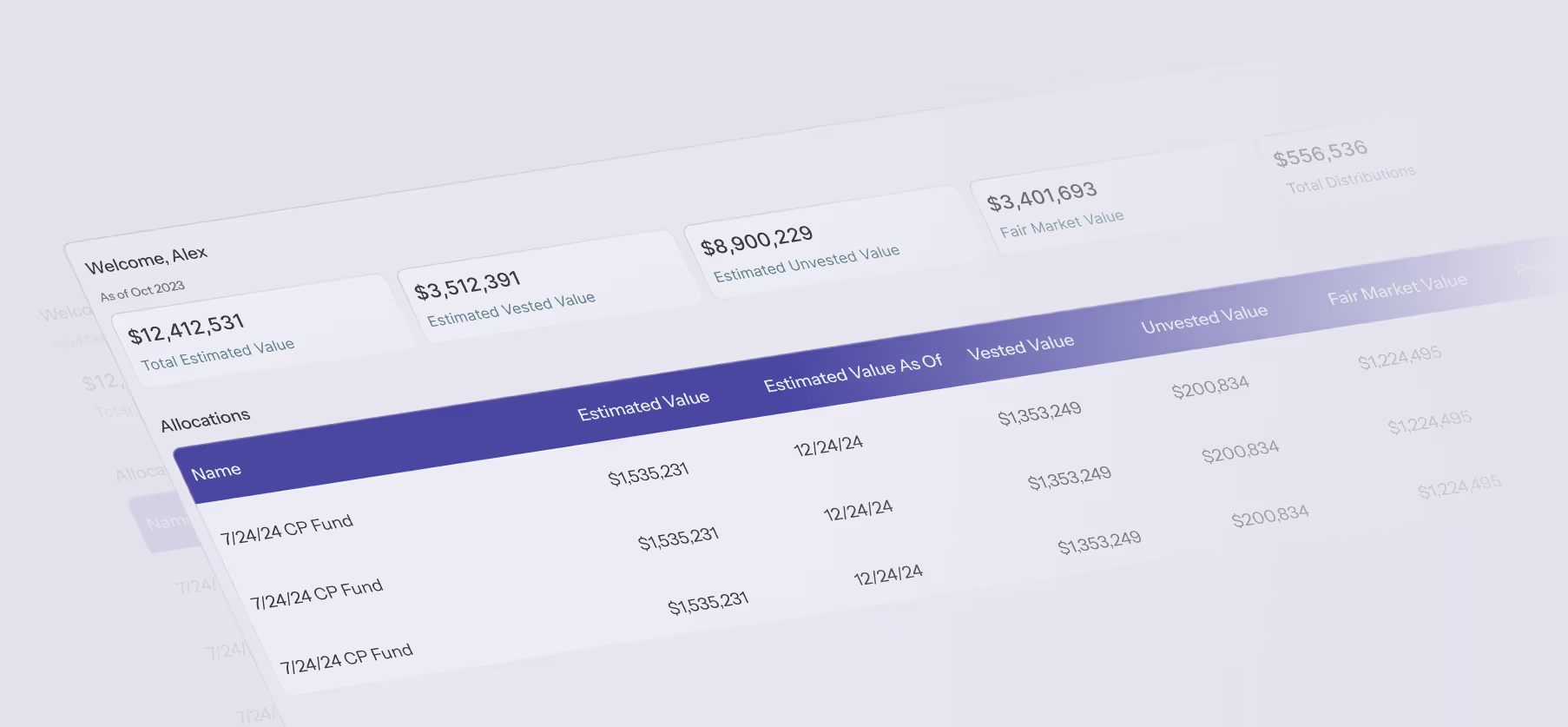
Navable provides carry forecasting directly from the firm's governed allocation data — projecting estimated carry values at the participant level under configurable performance assumptions. Participants see forecasted carry value (vested and unvested) through a dedicated portal, while leadership gets the aggregate view needed for compensation planning and financial modeling. No spreadsheet duplication required. Book a demo →
Related Questions
- How do you model carried interest scenarios?
- Tracking unrealized vs. realized carry
- Carry visibility for finance teams
- Tracking carry participation by employee
Common Questions
How accurate are carry forecasts?
Carry forecasts are estimates, not predictions — their accuracy depends entirely on the quality of the performance assumptions and the currency of the allocation data. The value isn't in precision but in giving leadership and participants a structured, data-driven range of expected outcomes rather than no visibility at all.
Should participants see their forecasted carry value?
Increasingly, yes. Providing participants with visibility into estimated carry value — alongside vesting status and total compensation — reinforces the retention value of the grant. Without it, carry feels abstract rather than tangible, which undermines its effectiveness as a compensation tool.
How often should carry forecasts be updated?
At minimum, quarterly — aligned with fund valuation updates. Forecasts should also be refreshed after material events: significant exits, new deployments, allocation changes, or performance revaluations that alter the expected carry pool.