Direct Answer
The core problem with managing carried interest in Excel is that spreadsheets have no built-in governance — no audit trail, no version control, no approval workflows, and no way to enforce consistency as allocations change across funds, participants, and time periods. Excel works for initial modeling, but it becomes an operational liability once carry needs to be tracked, reconciled, and defended at scale.
Why Excel Works at First — and Where It Fails
Every firm starts in Excel. For Fund I with a small team and static allocations, it's perfectly adequate. The model is simple, the creator understands every formula, and there's no need for anything more sophisticated.
The problems begin once carry becomes dynamic. Partners join and leave. Vesting schedules advance. Deal-level participation gets introduced. A second fund launches with different terms. Suddenly the spreadsheet isn't just a model — it's an operational system. And Excel was never designed to be one.
The Specific Risks
No audit trail. Excel doesn't natively track who changed what, when, or why. Cell-level edit history is limited, unreliable, and disappears when files are copied or shared. During an audit or LP inquiry, reconstructing the history of allocation changes becomes a forensic exercise — digging through emails, folder timestamps, and personal recollections.
Version control chaos. The moment a file gets emailed, saved locally, or copied to a new folder, version divergence begins. "Carry_Model_Final_v3_REVISED_JM_edits" is a symptom every CFO recognizes. When multiple people touch allocation data across multiple files, there's no reliable way to know which version reflects the current truth.
Key-person dependency. Complex carry models in Excel tend to become artifacts of the person who built them. Nested formulas, hidden columns, cross-sheet references, and undocumented assumptions create models that are functionally opaque to anyone else. If that person leaves the firm, the model becomes a liability overnight.
Manual reconciliation burden. When allocation data and distribution models live in separate spreadsheets — or separate tabs maintained by different people — every distribution cycle requires manual reconciliation. That process is time-consuming, error-prone, and concentrates risk at the exact moment when accuracy matters most.
No role-based access. Excel files are either shared or not. There's no way to give a partner visibility into their own carry data without exposing firm-wide allocations, or to let HR see compensation data without accessing fund economics. This forces finance teams into a cycle of producing one-off reports and manually redacted statements.
Scaling breaks everything. Each new fund, SPV, or co-invest vehicle typically requires its own spreadsheet or tab. The cross-references between them become increasingly fragile, and the time required to maintain consistency across the model ecosystem grows with every addition.
What Triggers the Shift Away from Excel
Most firms don't leave Excel proactively. They leave because a specific event exposes the risk: a distribution error traced back to a stale formula, an audit that requires weeks of reconstruction, a partner dispute over allocation changes that can't be verified, or simply the realization that the finance team is spending more time maintaining spreadsheets than doing actual analysis.
The common thread is that Excel stops being a tool and starts being a constraint — on accuracy, on speed, on auditability, and on the trust that partners and LPs place in the numbers.
How Navable Helps
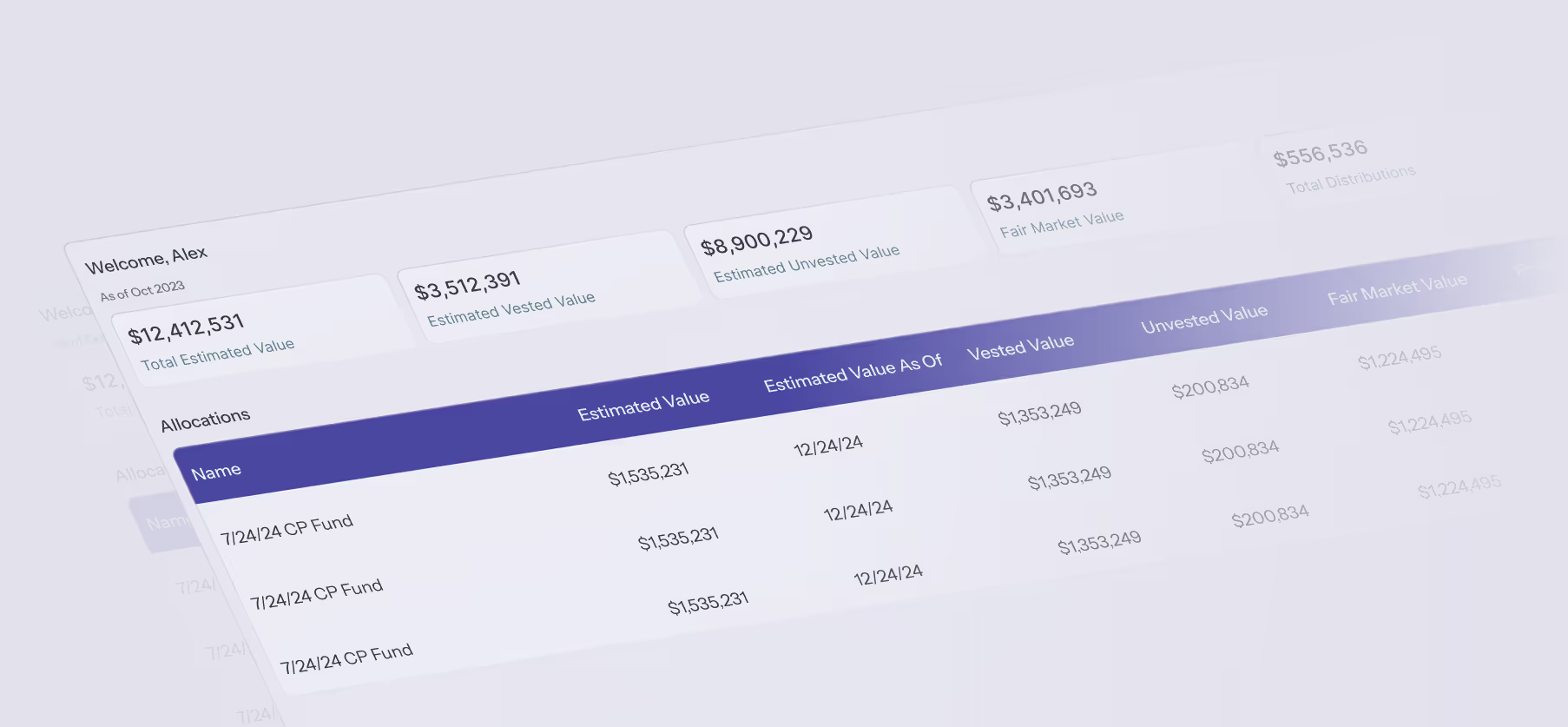
Navable replaces Excel-based carry management with a centralized, audit-ready platform. Every allocation change is tracked with timestamps and approvals. Reporting is automated and role-based. And the data that drives distributions, partner statements, and year-end audits lives in one governed system — not scattered across files that only one person understands. Book a demo →
Related Questions
- What is carried interest tracking software?
- How do you track carried interest allocations?
- What are carry allocation tracking best practices?
- How do you centralize carry data across funds?
Common Questions
When is Excel still appropriate for carry management?
Excel is reasonable for a single fund with a small, stable team and minimal allocation changes. Once you add a second fund, introduce vesting or deal-level participation, or face audit scrutiny, the governance gaps become too significant to manage manually.
What's the biggest risk of staying in Excel too long?
Distribution errors. When allocation data is stale, inconsistent, or unverifiable, the firm is distributing real dollars based on numbers it can't fully defend. That risk grows with every new fund and every allocation change.
How hard is it to migrate from Excel to a carry management system?
Less disruptive than most firms expect. The typical approach is to pilot with one fund — migrating its allocation data, vesting rules, and participant records into the new system — then expand from there. Navable's onboarding process typically completes setup in under three weeks.