
.svg)


Key Takeaways: Year-End Compensation Planning for PE
- Effective compensation planning starts with an honest review of 2025: who stayed, who left, what your comp structure actually drove, and where budget execution drifted from intent.
- The four strategic decisions that define your 2026 approach are total budget, compensation philosophy and mix, performance metrics, and retention priorities.
- A structured timeline (6 weeks before year-end through early January) prevents the rushed, error-prone process that leads to Q1 departures and broken trust.
- Simpler compensation structures outperform complex ones because they're easier for your team to understand, value, and explain to their spouse. Keep complexity in your systems, not in your team's understanding.
Every December, managing partners face the same high-stakes window: a few weeks to make compensation decisions that will determine whether their best people stay engaged, start entertaining recruiter calls, or quietly begin planning their exit.
Most firms treat this as an administrative sprint. Review numbers, set bonuses, update carry, schedule conversations, move on. The firms that retain and recruit consistently treat it as a strategic process that starts weeks earlier and extends well into Q1.
This is the guide to doing it right.
Step 1: Review 2025 Before Planning 2026
Before setting any numbers for next year, understand what happened this year.
- Retention and departures. Who stayed and who left? How did compensation factor into departure decisions? Were exits actually about money, or about poor communication of the value people already held?
- Performance outcomes. Did your comp structure drive the behaviors you wanted? If you emphasized deal origination through bonuses, did sourcing increase? If you allocated carry based on value creation, did portfolio performance improve?
- Budget execution. Where did you overspend or underspend, and why? Are you consistently exceeding budget on discretionary bonuses? Did you underspend on carry allocations, creating future retention problems you haven't felt yet?
- Competitive positioning. When recruiting in 2025, how did your offers compare? Did you lose candidates to compensation? Did you win talent too easily, suggesting room to optimize?
Red flags to address now:
- High performers expressing dissatisfaction or fielding outside offers
- Compensation gaps that don't reflect legitimate performance differences
- Structures so complex that your team can't explain their own comp
- Commitments made in 2025 that haven't been honored
Step 2: Make the Four Strategic Decisions
With your 2025 assessment complete, four decisions will define your 2026 approach.
Decision 1: Total Compensation Budget
Most PE firms fund compensation primarily through management fees, though structures vary. Some charge portfolio operations teams back to portfolio companies; others use hybrid models. Understand your firm's approach and the constraints it creates.
Build contingency for mid-year adjustments, new hires, and retention situations. Rigid budgets create problems the moment circumstances change.
Decision 2: Compensation Philosophy and Mix
Define the balance across your compensation components:
- Cash vs. carry ratio. Early-stage firms with less realized carry may emphasize cash. Established firms with strong fund performance can lean more heavily on carry.
- Base vs. bonus weighting. Higher base provides stability; larger bonuses create performance leverage.
- Carried interest strategy. Who receives carry, at what levels, and based on what criteria? This is your most powerful long-term retention tool.
- Co-investment opportunities. Allowing team members to invest personally alongside the fund builds wealth and deepens alignment. Consider offering leverage on co-invest terms to strengthen the incentive.
Decision 3: Performance Metrics
Balance quantitative results (IRR, MOIC, deals closed, value created) with qualitative contributions (leadership, mentorship, culture building, fundraising support). The best firms reward both results and behaviors.
Weight different roles appropriately. Investment professionals, operational partners, and fundraising leaders contribute differently, and your criteria should reflect those differences while maintaining fairness.
Decision 4: Retention Priorities
Identify the people you absolutely cannot lose. Not just top performers, but those with unique skills, relationships, or institutional knowledge that would be difficult to replace.
Create meaningful retention incentives:
- Vesting schedules and cliff structures in carry allocations
- Favorable co-investment terms with extended vesting
- Expanded responsibilities and career development commitments
Be proactive. Address flight risk before it becomes a resignation. Counteroffers rarely work. Proactive retention does.
The Year-End Execution Checklist
Strategy matters, but execution determines outcomes.
4-6 Weeks Before Year-End
Strategic planning:
- Review 2025 fund performance and distribution projections
- Gather market compensation data (Heidrick & Struggles, Glocap benchmarks)
- Conduct Managing Partner / Compensation Committee planning session
- Set total 2026 budget and allocation framework
- Identify retention risks and critical roles
Operational preparation:
- Audit current carry allocations and vesting schedules
- Review employment agreements for contractual obligations
- Validate carried interest calculations are accurate and ready to share
- Prepare scenario models for different compensation structures
- Coordinate with tax advisors on distribution timing
2-4 Weeks Before Year-End
Individual decisions:
- Finalize performance assessments
- Determine 2025 bonus amounts by team member
- Set 2026 base salary adjustments
- Allocate new carry grants or adjust existing allocations
- Structure any special retention packages
- Prepare offer letters for promotions or role changes
Communication planning:
- Draft compensation talking points
- Schedule one-on-one meetings with each team member
- Prepare documentation: salary letters, bonus letters, carry agreements
- Align the partnership on messaging and rationale
- Plan for difficult conversations
Systems and documentation:
- Update compensation tracking systems with 2026 decisions
- Generate carry projections to show team members during conversations
- Ensure all documentation is legally reviewed
- Prepare employee portal with updated compensation data and statements
Final Week / Early January
Execution:
- Conduct compensation conversations with all team members
- Deliver compensation statements
- Process year-end bonuses or distributions
- Execute new carry allocation agreements with signatures
- Update HR systems and payroll
Follow-up:
- Address questions and concerns
- Document any verbal commitments or future considerations
- Schedule Q1 check-ins for new performance expectations
- Begin tracking retention and satisfaction post-communication
Why Simpler Compensation Structures Win
One of the most common and damaging planning mistakes is overcomplicating structures. A carry allocation with multiple tiers, complex vesting, performance hurdles, and conditional provisions might be intellectually elegant. But if your VP can't explain their compensation to their spouse, the structure has failed its purpose.
What complexity actually creates:
- Team members don't feel appropriately rewarded when they can't understand what they have, even when the economic value is substantial
- Administrative burden multiplies with every additional provision, and spreadsheets buckle under the weight
- Retention conversations become nearly impossible when you can't quickly articulate what someone would forfeit by leaving
The clarity test: The best compensation structures are simple enough for a team member to internalize and explain. "My base is X, my bonus was Y, and I have Z% carry that vests over four years. Based on fund performance, that carry is projected to be worth W."
You can have performance-based components, vesting schedules, and retention incentives while maintaining that level of clarity. The key is making sure each component has a clear purpose and can be communicated in plain language.
Communicating Decisions Effectively
Even the right compensation decisions fail if delivered poorly.
Structure your conversations:
- Lead with appreciation and context before discussing numbers
- Connect compensation to specific performance and contributions
- Explain carry value with projections, not just percentages. "You're receiving 2% carry" is less meaningful than "Based on current fund performance, that's projected to generate $400K in distributions over the next four years"
- Listen and respond with empathy. Compensation conversations are emotional, even when the outcome is good
When compensation is below expectations: Be honest about the reasons. Vague explanations breed resentment. Clear feedback, even when it's hard to hear, builds respect.
Retention conversations with flight risks: Transparency about unvested carry can be your most powerful tool. Show the concrete numbers: vested vs. unvested points, projected value, what they'd forfeit by leaving. Have the conversation with data, not platitudes.
Post-Communication: The Work Continues
Compensation planning doesn't end with year-end conversations.
Immediate feedback loop. Pay attention to morale in the days and weeks after communication. Are people energized or deflated? Address lingering dissatisfaction before it festers. If you made a mistake, fixing it quickly demonstrates integrity.
Q1 check-ins. Schedule follow-ups that connect compensation to 2026 performance expectations. Monitor retention risk: sudden disengagement, recruiter conversations, reduced initiative. Early warning signs let you act before resignation.
Mid-year flexibility. Build in the ability to respond to changing circumstances. If fund performance exceeds expectations, if market compensation shifts, or if someone's contribution changes dramatically, mid-year adjustments may be appropriate.
Document for next year. Capture what worked and what didn't in your planning process. Did you start too late? Was communication unclear? Did your tools create bottlenecks? Fix these issues now so 2027 planning is smoother.
The Role of Purpose-Built Tools
Most firms start with Excel for compensation planning and carry tracking. It's familiar and flexible, but it breaks down quickly at scale.
During the high-pressure year-end window, spreadsheet limitations become acute:
- Complex carry allocations across multiple team members, funds, and vesting schedules create sprawling workbooks
- Multiple people modeling scenarios simultaneously creates version control problems
- Generating clean compensation statements means copying data into Word documents, introducing more error opportunities
- One missed formula update invalidates projections across dozens of cells
Navable is built for this.
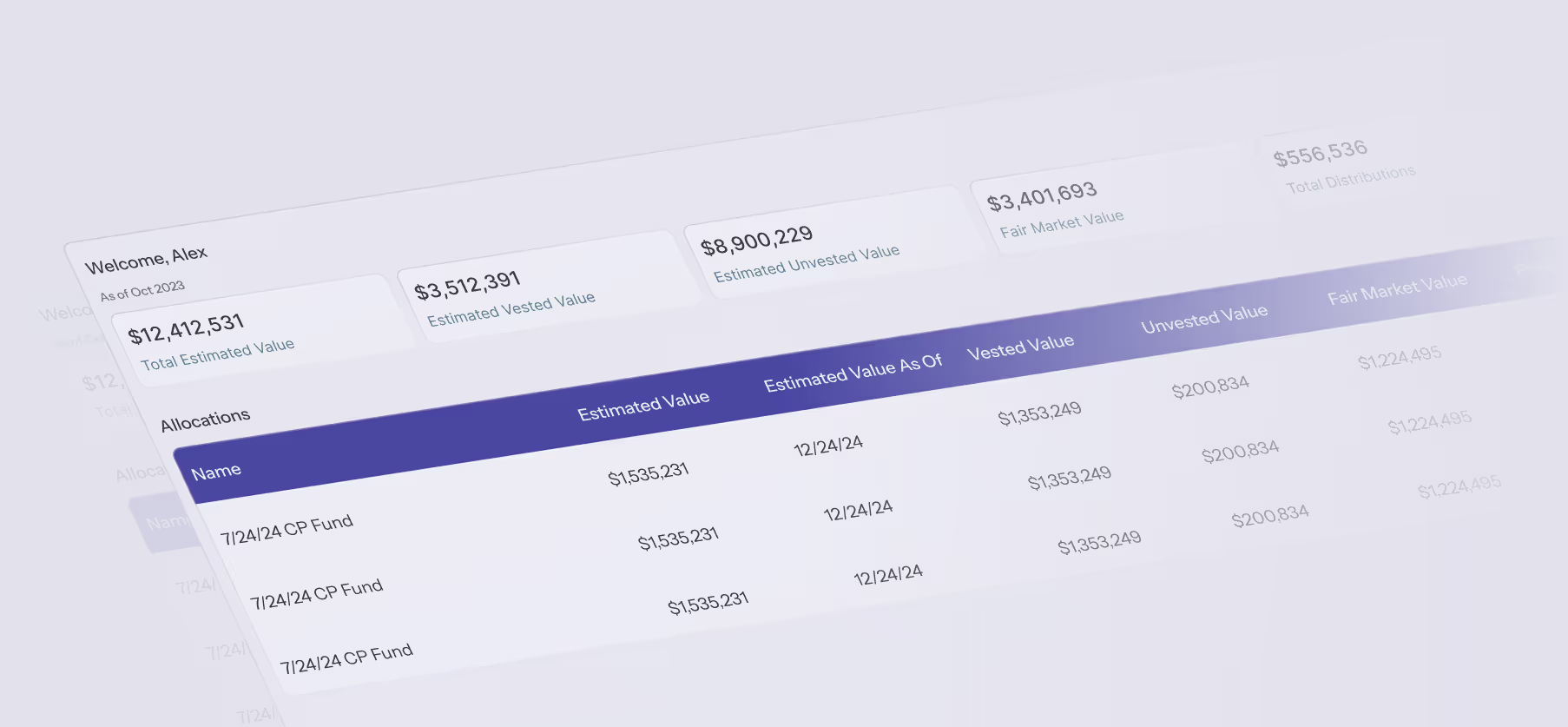
During year-end planning, the platform lets you model unlimited scenarios without errors, generate individual carry and compensation statements directly from governed data, track vesting automatically with a complete historical record, and show team members their carry value clearly so they understand and appreciate the full picture.
When your team can see their carry value, vesting schedule, and total compensation in one place, retention conversations become data-driven rather than abstract. Book a demo →
FAQs: Year-End Compensation Planning for PE Firms
When should compensation planning start?
At least six weeks before year-end. Firms that start in mid-December are already behind. The strategic decisions (budget, philosophy, retention priorities) need to be made before individual compensation conversations can be structured effectively.
How do you balance cash compensation with carry?
It depends on firm stage and fund performance. Early-stage firms with less realized carry typically emphasize cash. Established firms with strong performance can lean into carry as a larger share of total compensation. The key is that participants understand the value of their carry, which requires visibility tools, not just allocation percentages.
Should you use discretionary or formulaic bonuses?
Most firms benefit from a hybrid approach. Formulaic elements create clarity and reduce perceived favoritism. Discretionary components provide flexibility to reward contributions that formulas miss. The balance depends on your firm's culture and the behaviors you want to incentivize.
What are the biggest compensation planning mistakes?
Starting too late, overcomplicating structures, communicating poorly, and failing to show team members the projected value of their carry. The last one is particularly costly because it means your most powerful retention tool (carry) operates at a fraction of its potential.
How does carry management software help with year-end planning?
It eliminates the spreadsheet bottleneck. Instead of manually building compensation models and statements, you generate them from a single governed data source. Scenario modeling, carry projections, vesting tracking, and participant statements are all produced from the same system, ensuring consistency and accuracy during the highest-pressure period of the year.